

Please note that these long items are difficult to ship economically in small quantities. Please call, chat, or email for a quote, including shipping.
SEE ALL OF OUR LIVESTOCK OILERS
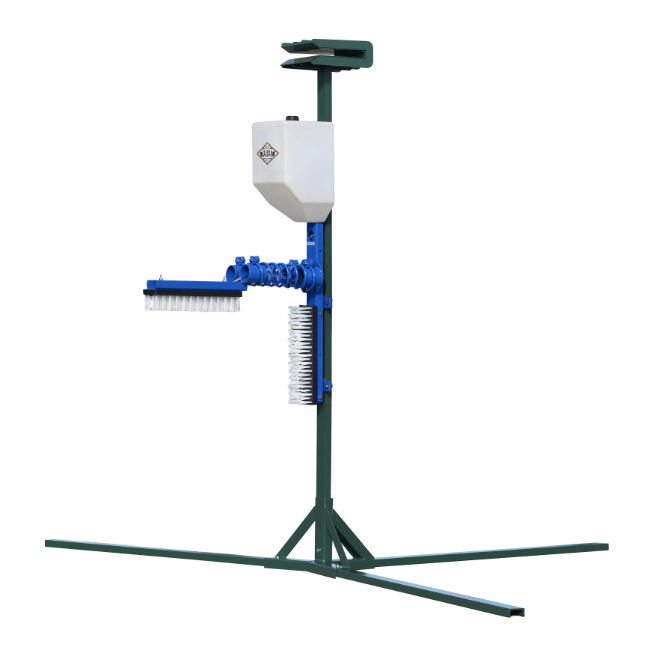
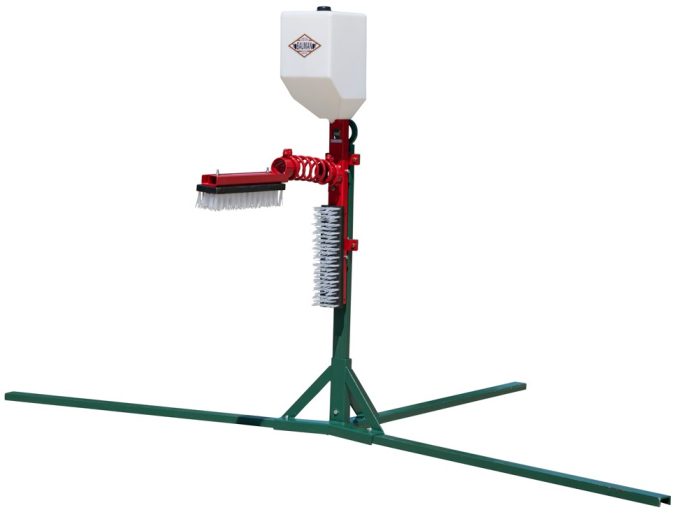
Oiler Stands provide a freestanding mounting option for compatible cattle and goat oilers in pastures, open lots, and other livestock areas where a fence, wall, or permanent mounting structure is unavailable. Available in 58-inch and 96-inch heights, these steel stands allow ranchers to position livestock grooming and treatment equipment where animals can reach it during normal movement.
The taller 96-inch stand includes a bucket hookup intended to assist with repositioning using suitable equipment, while the shorter 58-inch option may be appropriate for compatible goat oiler installations. Select the stand according to the livestock species, oiler model, installation location, and manufacturer compatibility requirements. Browse Barn World's cattle oilers and livestock grooming equipment for related products.
Shipping consideration: These stands have long structural components that can be expensive to ship individually. Contact Barn World for a delivered quote, particularly when ordering a small quantity.
Oiler Stand Specifications
| Freestanding Livestock Oiler Stand Options | |
|---|---|
| Available heights | 58 inches and 96 inches |
| Listed leg length | 6 feet 6 inches |
| Installation type | Freestanding |
| Intended livestock | Cattle or goats, depending on configuration |
| Taller stand feature | Bucket hookup on 96-inch version |
| Typical placement | Pastures and open livestock areas |
Compatibility note: Confirm the mounting arrangement and approved oiler models for the selected stand. The original listing does not establish that every cattle or goat oiler fits both stand heights.
Why Use a Freestanding Livestock Oiler Stand?
Some cattle and goat oilers require a secure structure to support the applicator while livestock rub against it. A freestanding stand provides a dedicated mounting location when an existing fence, building, or other structure is unsuitable.
This can be particularly useful in pastures where animals spend much of their time away from permanent handling facilities.
Positioning an oiler in an accessible area may encourage regular animal contact, but the stand itself does not dispense treatment or provide grooming action. Its function is to support a compatible applicator.
Choosing Between the 58-Inch and 96-Inch Stands
58-Inch Oiler Stand
The shorter stand is identified in the original product description as a useful option for goat oiler applications.
Its lower height may be appropriate for compatible smaller-livestock equipment, depending on the applicator design and the animals using it.
Before ordering, verify the intended oiler's mounting dimensions and the contact height required for your animals.
96-Inch Oiler Stand
The taller version is intended for compatible cattle oiler installations and includes a bucket hookup.
The hookup is described as allowing the stand to be picked up and repositioned using a tractor bucket or suitable handling equipment.
Follow the manufacturer's handling instructions. Do not assume the stand can be safely moved with an attached, filled oiler or while livestock are nearby.
Oiler Stand with a Poly-Tank Cattle Oiler
The original photograph below illustrates a cattle oiler with a poly tank mounted on a freestanding stand.

For an example of this applicator configuration, review the plastic-tank cattle oiler with two springs. Confirm whether the selected oiler and stand are sold separately and whether additional mounting components are required.
Oiler Stand Without an Applicator
This photograph shows the stand structure without an oiler installed, making it easier to see the frame arrangement.

Where to Place an Oiler Stand
Pastures and Open Lots
Freestanding stands may be useful where livestock have access to large open areas without convenient wall or fence mounting points.
Choose a location animals can approach and leave without crowding or becoming trapped.
Near Regular Livestock Travel Routes
Consider placing the oiler near an established animal travel route where contact is likely during normal activity.
Keep sufficient distance from gates, feeders, waterers, and other equipment to avoid obstructing movement.
Stable Ground
Select reasonably level, well-drained ground suitable for the manufacturer's required installation or anchoring method.
A freestanding design should not be interpreted as permission to place the stand on unstable ground or omit required securing procedures.
Accessible Maintenance Location
Position the equipment where the applicator can be inspected, filled, and maintained safely.
Prevent treatment products from contaminating feed, drinking water, or surrounding drainage areas.
Installing a Freestanding Oiler Stand
Installation requirements depend on the stand height, compatible oiler, and manufacturer's instructions.
1. Inspect the Components
Check the stand, legs, mounting points, and supplied hardware for damage or missing parts.
2. Select the Location
Choose a stable location with adequate clearance for the animals and the oiler's movement.
3. Assemble and Secure the Stand
Follow the manufacturer's assembly and securing instructions. Confirm that all structural connections are properly installed.
4. Attach the Compatible Oiler
Use the mounting components specified for the applicator and stand combination.
Do not drill, weld, or modify the frame unless the manufacturer approves the modification.
5. Check Livestock Contact Height
Confirm that the applicator can be contacted appropriately by the intended animals without creating an unsafe position or entanglement hazard.
6. Observe Initial Use
Monitor livestock during their first interactions with the equipment.
Look for excessive stand movement, loose connections, crowding, or signs that the oiler is positioned incorrectly.
How Oiler Stands Support Livestock Grooming
A cattle or goat oiler may use brushes, rubbing surfaces, springs, or other applicator components to allow animals to make contact during normal movement.
Depending on the attached product, the oiler may be designed for grooming or for applying an appropriately labeled livestock treatment.
The stand provides structural support but does not determine the treatment's effectiveness.
When using a pesticide or other treatment product, follow the product label for the livestock species, application method, preparation, protective equipment, and withdrawal restrictions where applicable.
Neither the stand nor the applicator guarantees elimination of external parasites or prevention of livestock disease.
Using the Stand with Different Cattle Oilers
Compatibility should be evaluated according to the mounting arrangement and intended animal-contact method.
Poly-Tank Spring Oilers
Some spring-mounted oilers use a poly reservoir and contact surfaces supported by the stand. Review the exact mounting requirements before selecting the stand height.
Steel-Tank Spring Oilers
Other applicators use a steel reservoir and spring-supported rubbing components.
Barn World also offers a steel-tank cattle oiler with two springs. Confirm stand compatibility rather than assuming the mounting arrangements are interchangeable.
Goat Oilers
Smaller livestock may require a lower applicator position. The 58-inch stand is described as suitable for goat applications, but the selected oiler and animal size still need to be considered.
Maintaining the Stand
Routine inspection is important because livestock repeatedly apply force to the attached applicator.
Inspect Structural Connections
Check bolts, fasteners, joints, and mounting points for loosening, wear, or damage.
Check the Legs and Frame
Look for bending, corrosion, cracks, or other signs of deterioration.
Confirm Stability
Inspect the stand's position and securing arrangement, especially after significant weather or repeated heavy animal contact.
Inspect the Attached Oiler
Follow the applicator manufacturer's instructions for checking brushes, springs, reservoirs, rubbing surfaces, and treatment distribution.
Remove Equipment from Service When Damaged
Do not leave a damaged or unstable stand accessible to livestock.
Cattle Oiler Stand Photographs
Oiler Mounted on Stand

The mounted applicator shows how a freestanding structure can support a livestock oiler without requiring an existing wall or fence.
Stand Frame Without Oiler
This second placement retains the original gallery view of the stand without an attached applicator.
Stand Leg Construction

The original close-up shows the stand's leg structure.
Steel-Tank Oiler on Stand

This image illustrates another cattle oiler configuration mounted on a freestanding frame.
Top of the Oiler Stand

The upper mounting area is visible in this original photograph.
Complete Freestanding Oiler Stand

This final original gallery photograph shows the complete stand configuration.
Planning for Pickup, Handling, and Freight
These stands have long components, making transportation an important consideration when ordering.
The original product listing specifically notes that small quantities can be difficult to ship economically.
When requesting a quote, provide the desired stand height, quantity, delivery ZIP code, and the oiler model you intend to install.
For the 96-inch version, confirm the manufacturer's requirements for using the bucket hookup and whether the stand must be empty or have the oiler removed before repositioning.
Do not assume standard parcel shipping or liftgate delivery is available.
Frequently Asked Questions
What heights are available?
The original listing identifies 58-inch and 96-inch stand options.
Which stand is intended for goats?
The shorter 58-inch stand is described as suitable for goat oiler applications. Confirm compatibility with the intended applicator.
Which stand is intended for cattle?
The taller 96-inch option is shown with cattle oiler configurations. The correct choice depends on the oiler model and livestock size.
How long are the stand legs?
The original product description lists the legs at 6 feet 6 inches. Confirm the dimensions for the specific version ordered.
Does the stand include an oiler?
The original listing does not clearly establish that an applicator is included. Confirm package contents before ordering.
Can the stand be used in a pasture?
Yes. Freestanding pasture placement is one of its intended applications, subject to appropriate installation and securing requirements.
Does the stand require a fence?
No existing fence or wall is required for mounting, but the stand must still be assembled and secured as directed by the manufacturer.
Can I move the stand with a tractor bucket?
The 96-inch version is described as having a bucket hookup. Use only the manufacturer's approved handling procedure and appropriate equipment.
Will any cattle oiler fit the stand?
Not necessarily. Verify mounting compatibility before ordering.
Does the stand apply insecticide?
No. The stand supports an applicator. Treatment delivery, when applicable, is performed by the attached oiler.
Can the stand improve cattle weight gain?
No specific weight-gain improvement is established by the product information. The stand's purpose is to provide a mounting structure for compatible livestock oilers.
Why is shipping expensive?
Long structural components can require special freight handling, particularly for small orders. Request a delivered quote before purchasing.
Order Oiler Stands from Barn World
Oiler Stands provide a freestanding mounting option for compatible cattle and goat oilers where permanent mounting structures are unavailable.
Choose between the 58-inch and 96-inch configurations based on the intended livestock, applicator compatibility, and installation requirements.
Because these stands can be expensive to ship individually, contact Barn World with your required height, quantity, and delivery ZIP code to request current pricing and freight information.