
Panels




Recently viewed
Livestock panels offer a modular way to build corrals, holding pens, sorting areas, gates, and compatible round-pen arrangements without installing an entirely permanent fence system. A useful panel must suit the animal species, the pressure livestock may put against it, the facility layout, and the connection hardware used to join sections. Height, tubing diameter, steel gauge, rail spacing and the actual panel length all matter.
Barn World offers cattle panels, corral panels, tall range panels, wire-filled panels, feeder panels, and compatible connectors. Current listings include 1½-inch round-tube panels, heavier 2-inch tube designs, and 1¾-inch oval-tube range panels. Some are appropriate for general holding pens, while others are designed for specialized feeding or close-containment areas. Compare the particular product specifications below rather than treating every panel as suitable for every animal.
Many panels are oversized freight items and may be most economical when shipped together. Before requesting a delivered quote, consider the number of panels and gates, the compatible connection system, and whether the destination can accept and unload a large shipment.
Compare Livestock Panel Types and Construction
These are representative specifications from Barn World's currently listed panel products. Actual model lengths, gauges, gates, hardware and rail arrangements vary, even within the same nominal height category.
| Panel type | Representative specification | Planning consideration |
|---|---|---|
| Cattle panel | 62 in. high; 1½-in. tubing; listed 16-gauge steel | Rounded top; check lengths, six-rail spacing and connections |
| Medium-duty corral panel | 62 in. high; 1½-in. tubing; listed 18-gauge steel | Chain-latch connections, rounded shoulders and mud legs |
| Heavy-duty corral panel | 60 in. high; 2-in. tubing; five rails | Square-top design and loop-and-pin connections on listed model |
| Tall corral or range panel | 72 in. high; 2-in. tubing; six rails | Check 2-in. frame, rail spacing, pin system and intended animal use |
| Oval-tube range panel | 63 in. high; 1¾-in. nominal oval tubing; six rails | Closer lower rails, U-latch system, mud legs and compatible gate panels |
| Wire-filled livestock panel | Approximately 50 in. high; welded wire infill | Smaller openings; verify wire mesh and species suitability |
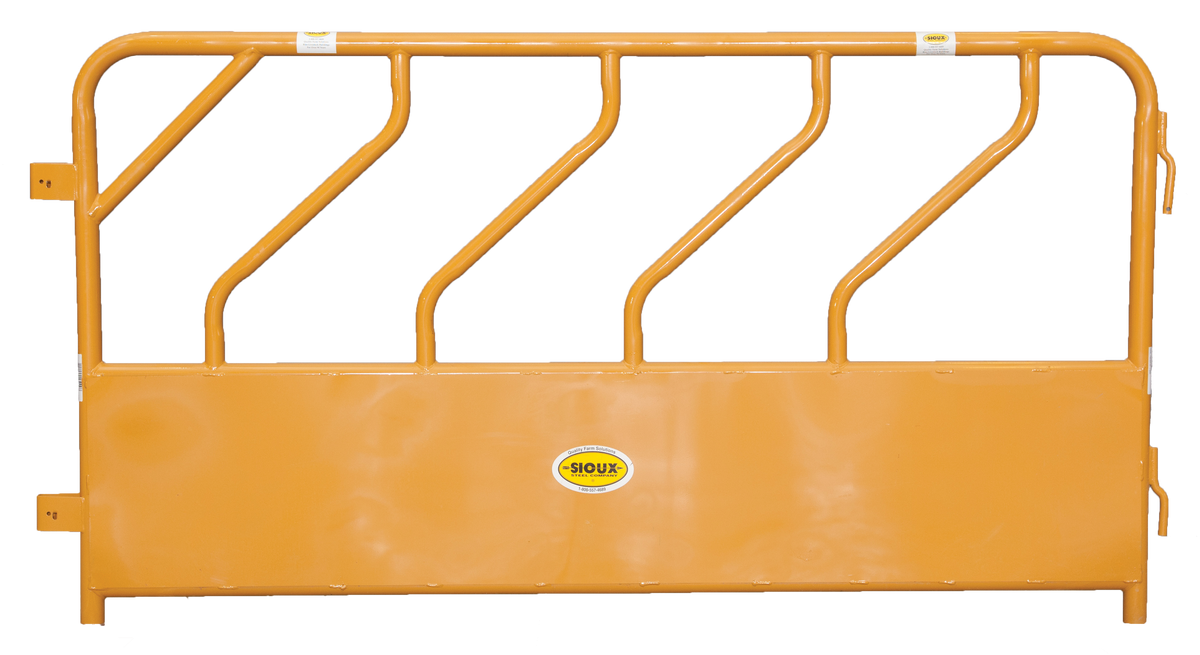
| Hay feeder panel | Approximately 50 in. high; model-specific feeding bars | Designed for hay access, not a universal containment panel |
The category also includes a separately sold range-panel connector. A connector is not a complete panel, and its advertised compatibility with tubing up to two inches does not mean it will safely join every model, manufacturer, or animal-handling system. The historical seven-foot wildlife panel is tagged discontinued and is not recommended as an available option.
Cattle Panels Versus Corral Panels
“Cattle panel” and “corral panel” can describe overlapping equipment, but construction details matter more than the label. Some portable panels use 1½-inch tubing with six horizontal rails; others use two-inch tubing with five or six rails. Height, steel wall gauge, bracing, and how the corners are formed affect practical applications.
Barn World's 62-inch cattle panel lists 16-gauge, 1½-inch tubing with a rounded top. The separate 62-inch corral panel lists 18-gauge tubing, rounded shoulders, vertical braces and chain-latch connectors. The two products therefore are not identical just because their nominal height is the same. Compare the actual steel gauge and connection system, especially if extending an existing corral.
A heavier frame may be preferable where mature cattle place greater pressure on a panel, but stronger tubing alone does not compensate for incorrect assembly, damaged hardware, loose connections or an unsafe layout. Confirm the intended animal size and the manufacturer’s recommended uses for each design.
Range Panels for Round Pens and Portable Livestock Enclosures
Range panels can be joined to build compatible portable pens, holding areas, and modular livestock fencing. Common considerations include the number of rails, the ability to connect sections at different angles, the stability of the base, the connector type, and whether a walk-through or bow-gate section is available.
Barn World lists a 63-inch-high, six-rail range panel using nominal 1¾-inch oval tubing with closer rail spacing toward the bottom and a U-latch connection. A separate 72-inch-high, six-rail range panel uses two-inch tubing and a different connection arrangement. Check that the panels, gate inserts, and connectors share an approved interface before combining them into a pen.
For horses, the size of a round pen should be selected based on the activity and the individual animal, including safe footing, sufficient working room, and avoiding exposed sharp edges. A cattle sorting pen, a horse-training round pen and a calf-holding enclosure can have very different space requirements. Do not infer that all livestock panels are equally suitable for horses or young stock.
For additional configurations and complete pen products, see Barn World's Round Pens collection. Check model and gate availability before estimating delivery or beginning site preparation.
How Many Panels Are Needed for a Round Pen?
A common preliminary method is to multiply the desired diameter in feet by about 3.14 to estimate the circumference, then divide by the chosen nominal panel length. That gives a starting estimate for the perimeter. Because the sections are straight rather than curved, the finished enclosure is a many-sided polygon rather than a mathematically exact circle.
The original Barn World planning chart is preserved below. These figures are approximate, not guaranteed order quantities or finished dimensions. Different panel systems, the actual assembled panel length, connector spacing, and the size of a walk-through gate or bow gate affect the resulting pen diameter. Confirm the exact layout and number of components before placing a freight order.
| Diameter Of Holding Pen | ||||||||||||||
| Panel Length | ||||||||||||||
| 6 | 8 | 9 | 11 | 13 | 14 | 16 | 17 | 19 | 20 | 22 | 24 | 25 | 27 | |
| 5 | 7 | 8 | 9 | 10 | 12 | 13 | 14 | 15 | 16 | 18 | 20 | 21 | 22 | |
| 4 | 5 | 6 | 7 | 8 | 9 | 10 | 11 | 12 | 13 | 14 | 15 | 16 | 17 | |
Round-pen planning note: Some 10-, 12- and 16-foot panels have actual manufactured lengths several inches shorter than their nominal names. For example, Barn World lists certain 62-inch cattle panels as five inches shorter than their nominal lengths and certain 63-inch range panels as 5¼ inches shorter. Gates may also have different effective lengths. The chart should be used only as an initial layout reference; your supplier should verify the exact geometry, gate opening and connector requirements.
For a finished circular training pen, also account for a separate gate, its swing or latch clearance, suitable footing and a level installation area. Do not assume the numbers shown here mean that any series of randomly mixed panels will close into a safe enclosure.
Panel Height, Tubing Diameter, and Steel Gauge
Panel height helps determine which livestock can be safely contained, but height alone does not establish strength or suitability. Compare the full construction: steel wall gauge, tubing diameter or oval profile, number and spacing of horizontal rails, supporting posts, welded joints, and connections to adjacent panels.
In many steel gauge systems, 16-gauge tubing has a thicker wall than 18-gauge tubing of the same type. Heavier wall material may resist certain loads better, although overall performance depends on welds, spans, geometry and the complete installed system. The two-inch tube range panels and 1½-inch round-tube panels should therefore not be compared on diameter alone.
Some livestock panels have 14-gauge vertical posts with 16-gauge horizontal rails, while others use a single gauge or oval tubing. Consult the individual product listing for the correct combination. A tall panel with wide openings is not automatically appropriate for young calves, sheep or goats that may pass through or become caught.
Rail Spacing and Animal Safety
The open spaces between rails should be appropriate for the animals that will use the enclosure. Head, legs, hooves, horns, and tack may become caught in poorly matched openings, especially when an animal is frightened or pushed against a barrier. Smaller livestock may require tighter rail spacing or wire-filled panels rather than a general cattle corral panel.
A wire-filled panel can reduce some of the larger gaps found between ordinary rails, but the welded mesh and frame still need to be inspected for damage, snagging points and proper attachment. Do not treat the infill as an assurance that every species or age group can be confined without injury.
Horses need particular attention to exposed projections, panel corners, and gaps at connectors. Inspect the intended animal-contact surfaces and choose a model suited to the horses’ size and behavior. Where cattle will be worked under significant pressure, evaluate the panel system for that handling duty rather than using lightweight paddock fencing in a forcing alley.
Panel Connectors: Chain Latches, Pin-and-Loop, and Flexible Joints
Modular livestock panels depend on connections as much as their rail construction. Some Barn World products use chain latches, others use loop-and-pin joints or a dedicated U-latch system, and compatible flexible connectors use a steel hook with a rubber strap. These are different systems and should not be assumed interchangeable.
The separate range-panel connector product is described for compatible tubing up to two inches in diameter, with replacement straps available for specified models. Check the mounting shape and the requirements for the actual panel or gate before ordering; one universal-sounding description does not establish compatibility with every oval or round-tube frame.
At installation, inspect whether the connection is fully engaged and whether a panel can be lifted or forced out of position. A loose joint can create a dangerous gap or allow a gate to swing unexpectedly. Replace missing pins, worn straps, or damaged hardware with approved parts rather than improvising a wire or rope substitute.
Corral Layout, Gates, and Expansion Planning
Good corral design begins with the number and size of livestock, the purpose of each pen, access for water and feed, and the intended path to working or loading equipment. A simple rectangular holding pen, a round pen and a crowding area may require different panel types and gate locations.
University extension guidance emphasizes planning gates, drainage, animal flow, sorting areas and the possibility of future expansion. Too few gates or poorly located openings can make routine handling difficult, even when the fencing material is strong. For cattle-working layouts, consider the connection to your existing Livestock Working Equipment rather than selecting panels independently of the chute and alley.
Measure the full assembled length of each side, including connectors and gates. Check that gate leaves can open fully without striking equipment, and avoid forcing animals into blind corners or narrow passages. Leave room for people and machinery to enter, clean, and maintain the facility.
Consider how the system will be anchored or stabilized, especially on uneven ground or where animals exert pressure. Portable panels do not automatically have the same resistance to leaning or impact as a properly engineered permanent fence. Follow the manufacturer's specifications for each application.
Feeder Panels Are Not Regular Containment Panels
Feeder panels use bars or openings designed to let livestock reach hay or other appropriate feed. Barn World's 50-inch-tall feeder panel listing describes model-specific bar arrangements and various lengths. It is a specialized feeding component and should not automatically be substituted for a structural corral panel in a high-pressure handling area.
Consider feed-bale size, how the animals will approach the feeding side, the number of usable positions, and whether hay may fall to the ground. A longer feeder panel may allow more feeding access, but it does not by itself prevent dominance or feed waste. Maintain suitable footing and remove spoiled or contaminated feed regularly.
Check whether the product uses slant bars or another arrangement, and confirm the actual length and included connections. Different feeder designs and product variants may not have identical bar spacing, frame gauge, or compatibility with corrals.
Freight Shipping and Bulk Panel Quotes
Most large livestock panels are impractical to ship as standard packages. Freight depends on the length, height, weight, quantity, whether panels can be stacked safely, the destination, and how they will be unloaded. A single long panel may be costly to move because its dimensions restrict the carrier’s options.
Before requesting a quote, prepare a bill of materials that identifies each panel style, nominal length, quantity, gate type, and connection hardware. Confirm the exact shipped dimensions and whether the manufacturer offers compatible accessory panels or gate inserts. Do not assume equipment from different product families can be combined without adapters or approval.
Provide Barn World with the delivery ZIP code, unloading equipment, any restricted truck access, and whether the panels will ship to a business or ranch location. Larger orders may change the per-panel freight economics, but any savings depend on the actual shipment. Compare the complete delivered cost rather than the listed price of one panel.
Inspection and Maintenance for Outdoor Livestock Panels
Livestock panels are exposed to animals, mud, weather and equipment impacts. Inspect welds, hinges, connectors, support feet, ground contact points and coatings at reasonable intervals. Powder coating may help resist weathering, but it should not be treated as immunity to rust, especially where steel becomes exposed.
Remove sharp or broken hardware promptly and repair damaged panels according to the manufacturer's recommendations. Replace missing latch parts and check for joints that can open when a panel is pushed or lifted. Maintain drainage around pen entrances and gate posts where traffic may create mud or uneven footing.
After relocating a portable pen, inspect all connections before introducing animals. A layout that was stable in one pasture may be less secure on sloping or rocky ground. Confirm that gates latch and that animals cannot push the assembly into a hazardous position.
Frequently Asked Questions About Livestock Panels
What is the difference between cattle panels and corral panels?
The terms overlap. Compare the actual height, tubing size, gauge, number of rails and connector system. Different Barn World models have different frames despite similar names.
Are 16-gauge livestock panels stronger than 18-gauge panels?
All else equal, thicker steel can affect strength, and 16-gauge tubing is generally thicker than 18-gauge tubing in the same steel gauge system. Overall panel strength also depends on tubing shape, joints, braces and installation.
How tall are Barn World's range and corral panels?
Current examples include approximately 60-, 62-, 63- and 72-inch-high panels. The appropriate height depends on animal size, rail spacing and the intended enclosure.
How do I calculate the number of panels for a round pen?
Use the desired approximate circumference and panel length for an initial estimate, then verify the actual straight-panel geometry, connector spacing and gate dimensions. The preserved chart above is for rough planning and does not guarantee the final diameter or panel quantity.
Can I mix panels from different manufacturers?
Only when the connectors, dimensions and load requirements are verified as compatible. Chain-latch, U-latch and pin-and-loop systems are not automatically interchangeable.
Are wire-filled panels good for smaller livestock?
Wire infill can reduce large openings, but the actual mesh, frame height, animal behavior and entrapment risk still must be checked for the species and age group.
Do all panels include gate sections?
No. Some product ranges offer separate gates or gate inserts, while other listings are for plain panels or connector accessories. Check the actual configuration being quoted.
Can feeder panels be used as a regular cattle fence?
Not automatically. Feeder panels have openings designed for feed access and may not be rated for the same containment or handling pressure as a regular corral panel.
Do panels have the exact nominal length shown in their titles?
Not always. Some listed models have actual panel lengths several inches shorter than the nominal length. Check the specification sheet before calculating a complete enclosure.
What is needed for a livestock panel freight quote?
Provide the panel model, height, length, quantity, gates, connectors, destination ZIP code, and unloading equipment. Ask about stacking and delivery restrictions for oversized panels.