
Poly Stock Tanks
Recently viewed
Poly stock tanks provide a rust-resistant alternative to galvanized steel troughs for cattle, horses, sheep, goats, and other livestock. These molded polyethylene tanks are available in round, round-end, and selected rectangular configurations. The best choice depends on the amount of water needed, the animals' drinking height, the shape of the pen or pasture, the available supply line, and how the tanks will be delivered.
Barn World carries Hastings and Sioux Steel poly stock tanks, including round models with several hundred to more than a thousand gallons of capacity, elongated round-end tanks, and a large rectangular tank that can be configured for certain secondary containment or watering applications. Products are not interchangeable: drains, reinforcement, available capacities, and intended uses vary by model.
Before ordering: Most of these tanks are large freight items designed to nest together during shipment. Several product listings specifically say they cannot ship one tank individually. Multiple-unit orders, truckload arrangements, or supplier pickup may be necessary. Check the shipping notes of the exact model and request a delivered quote with the required quantity.
Compare Round, Round-End, and Rectangular Poly Tanks
Shape affects where a tank fits and how livestock approach the water. A round trough can suit an open watering location, while a round-end tank may fit a narrower pen. The rectangular containment tank has a different construction and may require additional bracing for approved applications.
| Poly tank | Listed capacities | Important buying consideration |
|---|---|---|
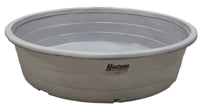
| Hastings round poly | Approximately 320, 580, and 1,100 gallons | 6-, 8- and 10-ft nominal diameters; large-unit shipping restrictions |
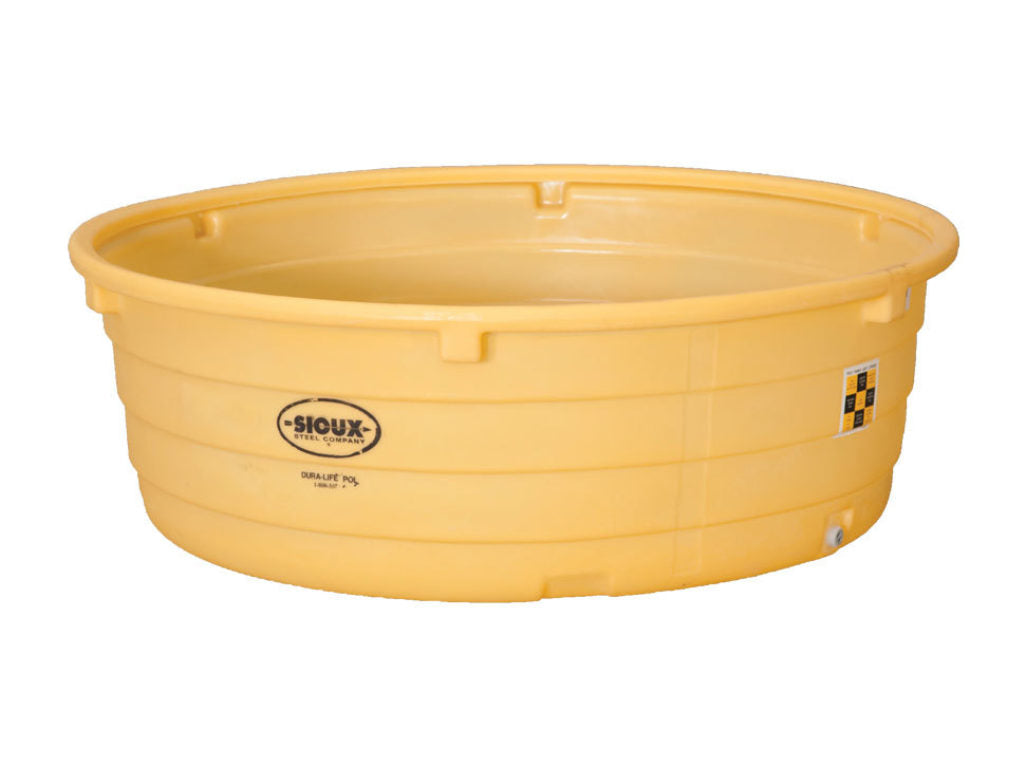
| Sioux Steel round poly | Approximately 335, 530, and 950 gallons | 6-, 7.5- and 9-ft nominal diameters; compare rim height and tank depth |
| Round-end poly tanks | Multiple sizes; capacity depends on manufacturer and length | Longer, narrower footprint; check drains, wall specifications and nesting |
| Rectangular poly containment tank | 750 gallons on the listed model | 96 × 86 × 28 in.; cross braces specified for stock-tank and aquaponics use |
Capacities and dimensions in the table are based on current Barn World product descriptions. Sizes may be nominal; rim projections, cross braces and shipping clearances should be checked with the actual product drawings. A tank's claimed gallon capacity is not a manufacturer guarantee of a particular number of livestock served.
Hastings Round Poly Stock Tanks
The Hastings round poly range includes nominal diameters of six, eight, and ten feet, with corresponding listed capacities of approximately 320, 580, and 1,100 gallons. The product descriptions identify UV-resistant, high-density virgin polyethylene and reinforced rim construction for outdoor livestock use.
The six- and eight-foot models are listed with depths of approximately 24 inches, while the ten-foot model is approximately 28 inches deep. This matters when selecting a tank for smaller livestock or installing a unit in a site with fixed access dimensions. Check both the actual outside rim and the animals' comfortable drinking height.
Large poly tanks can be light relative to the water they hold, but they occupy significant freight space. The Hastings product listing notes that individual tank shipment is unavailable and that ten-foot models generally require large-quantity freight or pickup at Hastings, Nebraska. Contact Barn World about availability and feasible order quantities rather than assuming ordinary single-item delivery.
Sioux Steel Round Poly Water Tanks
The Sioux Steel range includes round poly tanks with listed capacities of approximately 335 gallons at six feet in diameter, 530 gallons at seven and a half feet, and 950 gallons at nine feet. The corresponding depths are about 24 inches for the two smaller models and 28 inches for the largest. Verify the selected model's actual outside dimensions and empty weight before arranging delivery or placing the tank.
The one-piece molded poly body resists rust and corrosion. A rounded upper edge can be useful where animals drink directly over the rim, but it does not eliminate the need to inspect the tank for impact damage, cracks, wear or unsuitable alterations. Poly walls should be supported and used as specified by the manufacturer.
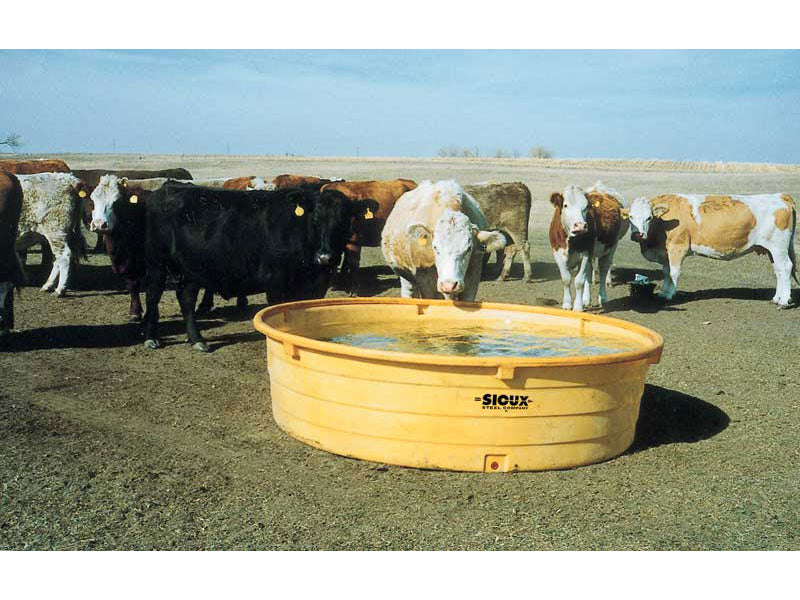
For pasture locations, consider how much of the rim animals can actually reach. A tank placed close to a fence may lose part of its usable drinking perimeter, increasing crowding. The correct size depends on both the stored water and the rate at which the water supply can refill the tank.
Round-End Poly Tanks for Narrower Watering Areas
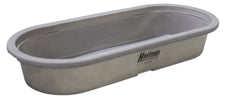
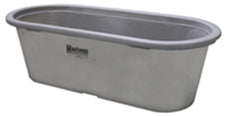
Round-end tanks have two longer sides with curved ends. This footprint can be useful along a suitable fence line or in an elongated pen where a large round tank would obstruct animal movement. Several Barn World round-end poly ranges use molded one-piece construction, rounded corners and model-specific drains.
The Hastings round-end line describes high-density polyethylene with a reinforced closed lip and, on the listed two-foot-tall models, a screw-in drain plug. Another round-end model family notes that its bulkhead drain fitting ships separately for installation. Check the exact drain configuration and whether any fittings must be assembled before use.
Tank-wall thickness and dimensions vary. The current listings identify different wall-thickness figures for different sizes, so one general thickness claim would be misleading. Review the individual model's dimensions, nominal capacity and installation requirements, particularly if the tank will be used with a hog drinker or other side-mounted accessory.
Some large round-end poly tanks are designed to nest together to minimize freight volume. Hastings states that shipping one tank is not available for the relevant range and that orders of roughly three or more are typically needed for economical shipping. Other model lines may have different freight thresholds; request a quote for the exact assortment.
Rectangular Poly Tanks for Watering and Secondary Containment
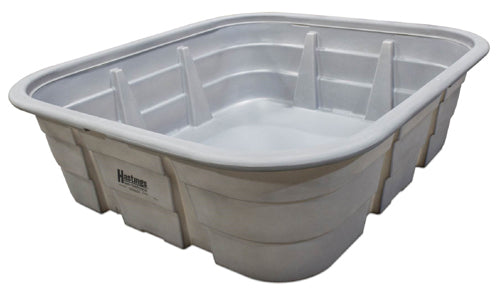
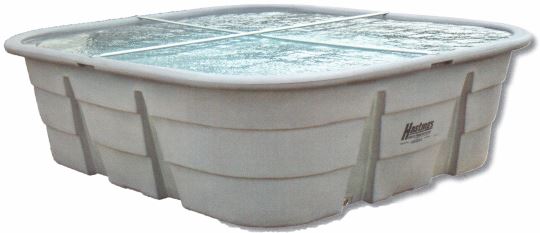
Barn World also lists a large rectangular polyethylene tank with an approximate 750-gallon capacity and outside dimensions of 96 by 86 by 28 inches. It is described primarily as a secondary containment tank but may be used for livestock watering in an approved configuration. The listing specifies additional cross braces for use as a stock tank or aquaponics tank.
A secondary containment application is not the same as ordinary livestock watering. If the tank will hold another substance or act as a containment basin, verify the chemical compatibility of the polyethylene, anticipated temperature, applicable regulations and the manufacturer's approved use. The presence of a large tank in a livestock category does not establish that it is approved for every industrial chemical or aquaculture application.
For watering, verify the proper placement of the support braces, drain fitting, accessible rim height and location. Do not omit braces that the manufacturer requires or assume the tank can support loads outside its intended configuration. Its large shipping footprint makes combined orders and suitable unloading arrangements particularly important.
Why Polyethylene Stock Tanks Resist Rust
Polyethylene does not contain iron and therefore cannot develop iron-oxide rust in the way exposed steel can. That makes poly tanks useful where water chemistry, manure exposure, or routine moisture create a concern about corrosion of metal surfaces. Many of the listed models also incorporate UV protection for outdoor service.
Rust resistance is not the same as being indestructible. Poly tanks may be damaged by heavy equipment, sharp objects, improper lifting, excessive heat, unsupported loading, or unsuitable chemical exposure. Their walls can also deform if used without required reinforcement. Check the tank's specific material claims, operating limits and manufacturer care instructions.
Most models are designed to rest on a suitable, reasonably level surface. A heavy tank filled on uneven, rocky ground can experience localized stress and may become difficult to empty safely. Preparing the base and managing drainage around it are part of a reliable installation.
How to Choose the Right Gallon Capacity
Capacity should be chosen according to livestock water consumption, the rate of supply, and how frequently the tank may need to be refilled. Stored gallons are important for remote pastures or intermittent pumping, but a large tank does not solve a broken supply line or a valve that cannot maintain the water level during peak demand.
Use species-appropriate water-consumption guidance to estimate daily needs, then consider how the herd uses the water throughout the day. Lactating animals, hot weather, high-dry-matter rations and the size of the animals can change demand. A watering point may have enough water overall but too few accessible drinking positions for a crowded group.
Where solar pumping, windmill supply or hauled water is used, consider the longest plausible gap between fills. Large poly reservoirs may offer useful stored capacity, but water quality must still be monitored. Avoid selecting a tank so large that water sits without adequate turnover and cleaning.
Drinking Height, Animal Access and Tank Placement
Rim height affects accessibility. A tank suitable for adult cattle or horses may be too deep or tall for smaller sheep, goats or calves. Check the selected tank's actual rim height and whether the animals can drink safely without standing on the rim or stepping into the reservoir.
For pens containing several species or different sizes of animals, assess the needs of the smallest animals as well as the largest. Some tanks may accommodate model-specific side-mounted drinkers or fittings, but these modifications need to follow the manufacturer's instructions to avoid leaks or damaged walls.
Place the tank where the ground is firm, drainage is managed, and animals can enter and leave without becoming trapped against a gate. The tank should not obstruct animal movement or access for cleaning and refilling. Verify that the delivery path is large enough for the empty tank, including its protruding rim, before it arrives.
Drains, Cleaning and Long-Term Maintenance
A drain fitting makes regular cleaning more convenient, but the presence, thread size and location of drains differ between products. Many listed round-end models include or support drains; check whether the plug or bulkhead fitting is installed or supplied separately. Plan where the water will go before draining a large tank, since sudden discharge can erode the surrounding ground.
Remove accumulated sediment, algae, feed particles and other contamination using a cleaning process safe for the tank material and the animals. Do not assume that seamless walls prevent algae or bacteria from developing. Inspect the rim, base, corners and fittings for cracks, abrasions or stress marks after severe weather, relocation or heavy livestock traffic.
Never lift or move a tank while it is filled with water unless the manufacturer specifically approves the operation and equipment. Water adds considerable weight, and an unsupported tank can be damaged even when its empty weight is modest. Follow the maker's procedures for storage, stacking and transportation.
Can Poly Stock Tanks Be Used in Winter?
Many poly stock tanks are intended for outdoor agricultural use, but an ordinary open tank can still freeze. The polyethylene itself does not supply electric heat or make the drinking surface ice-free. Winter watering may require a compatible heater, an appropriate water supply arrangement or a different purpose-built heated waterer.
Use only heaters or heating systems approved for the specific tank material and installation. Protect cords from livestock and follow electrical-safety requirements. A generic metal-tank heater may be unsuitable for polyethylene or for a liner. Inspect the waterer during freezing weather and maintain a backup plan for power or supply failure.
Bulk Shipping, Nesting and Freight Quotes
The main freight challenge with large poly stock tanks is their shipping volume. Manufacturers often design tanks to nest inside one another, allowing several units to occupy less total truck space than separate, unstacked tanks. Freight may still involve a large truck, a flatbed or special handling at the delivery destination.
Some Hastings and other listed poly models explicitly cannot be shipped individually. Certain ranges cite a typical minimum of three or more, and the 750-gallon rectangular model notes that approximately five units are generally required for economical shipping. Large ten-foot-diameter Hastings tanks may be restricted to sizable shipments or supplier pickup. These are model-specific terms, not a universal minimum for every poly tank.
Before ordering, send Barn World the model, dimensions or capacity, quantity, delivery ZIP code, and unloading capabilities. Ask which sizes can nest together and what shipment arrangements are feasible. If only one unit is needed, contact Barn World before assuming a freight carrier can accept it or that the delivered cost will be reasonable.
For metal alternatives or much larger field-assembled reservoirs, see the broader Stock Tanks guide and our Galvanized Stock Tanks category. These options have different construction and freight requirements.
Frequently Asked Questions About Poly Stock Tanks
What is a poly stock tank made from?
It is a livestock water tank made from molded polyethylene. Many of Barn World's listed models are one-piece tanks with UV-resistant material; exact resin and construction details vary by product.
Are poly stock tanks better than galvanized steel?
Poly avoids iron rust, while galvanized steel offers rigid metal construction. Compare dimensions, livestock use, drain fittings, site conditions and delivery requirements rather than treating either as universally better.
How big are Hastings round poly tanks?
The current Hastings round range includes approximately 320-, 580- and 1,100-gallon sizes, with nominal diameters of six, eight and ten feet respectively.
What sizes do Sioux Steel round poly tanks come in?
Current listings show approximately 335-, 530- and 950-gallon round tanks with nominal diameters of six, seven and a half, and nine feet.
Can I order a single poly stock tank?
Some product lines cannot ship individual tanks because of their large size. Minimum practical quantities and pickup options depend on the model. Confirm availability and freight with Barn World before ordering.
Do poly stock tanks have drain plugs?
Many do, but the fittings and installation vary. Check whether the selected model includes an installed drain, a separate bulkhead fitting, or another configuration.
Can I add a drinker or float valve to a poly tank?
Some models permit compatible accessories. Confirm mounting, wall reinforcement, pressure and approved fittings with the manufacturer before modifying a tank.
Are poly stock tanks freeze-proof?
No. The tank material does not keep an ordinary open water surface from freezing. A suitable winter watering solution may require an approved heater or a different heated system.
What is the difference between round and round-end poly tanks?
Round tanks have a circular footprint. Round-end tanks have straighter sides and curved ends, making them useful in some narrower pens or fence-line layouts.
What is special about the rectangular containment tank?
The listed rectangular model holds approximately 750 gallons and has specific cross-brace requirements for stock-tank and aquaponics applications. Chemical containment uses require separate suitability checks.
What should I include in a poly stock tank freight request?
Provide the manufacturer or model, size, capacity, quantity, ZIP code and available unloading equipment. Note any limited truck access and ask about nesting or supplier pickup.