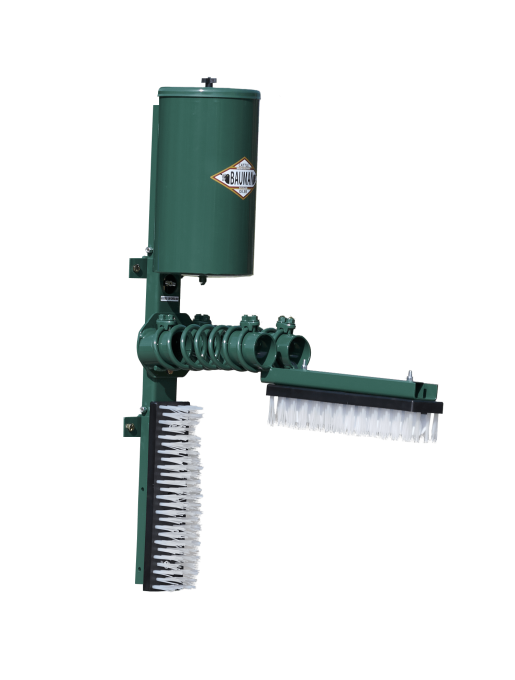
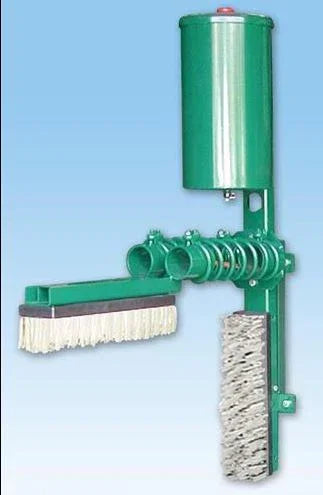


The Double-Spring Steel-Tank Cattle Oiler is a heavy-duty livestock grooming and liquid-application unit designed for cattle that naturally rub against stationary brushes. It combines a 3-gallon steel reservoir, adjustable grooming brushes, a dual-spring top brush assembly, and a pressure-activated valve that dispenses compatible treatment liquid when cattle engage the brush.
The spring-loaded brushes provide a rubbing surface that can help cattle remove loose hair and surface debris. When used with an appropriately labeled livestock treatment, the liquid-application system can also serve as part of an integrated external parasite management program. Explore Barn World's cattle oilers and grooming brushes to compare available configurations.
Double-Spring Cattle Oiler Specifications
| Feature | Specification |
|---|---|
| Reservoir capacity | 3 gallons |
| Reservoir construction | Steel |
| Overall height | 5 feet |
| Top brush assembly | Double spring-loaded |
| Grooming brushes | Adjustable |
| Liquid control | Pressure-activated valve with adjustable flow |
| Supply line | Listed as diesel fuel-resistant |
| Listed shipping weight | 90 pounds |
| Listed shipping dimensions | 12 × 12 × 60 inches |
How the Double-Spring Cattle Oiler Works
The cattle oiler combines mechanical grooming with a controlled liquid-delivery system. Its upper steel tank supplies liquid through the application system to a pressure-sensitive valve located in the brush assembly.
When cattle rub against the brush, the movement activates the valve and allows liquid to reach the application area. The valve is designed to remain closed when the brush is not being used, helping limit unnecessary dripping.
An adjustable flow control allows the operator to set the delivery rate according to the equipment instructions and the label requirements of the approved treatment product.
The system is designed for animal-activated application, but proper operation still depends on correct adjustment, suitable treatment liquid, routine inspection, and functioning mechanical components.
Why Choose a Double-Spring Cattle Oiler?
Two Springs Support the Top Brush
The dual-spring design provides resistance and movement as cattle rub against the upper grooming brush. This arrangement is intended for repeated contact during normal livestock use.
Compared with a single-spring configuration, the double-spring arrangement provides a different brush support design. The appropriate model depends on the cattle being managed, installation conditions, and the operator's preference.
Three-Gallon Steel Reservoir
The 3-gallon steel tank supplies the liquid-application mechanism. Its capacity can reduce the frequency of refilling compared with smaller reservoirs, depending on herd use and the adjusted dispensing rate.
The tank should be inspected regularly for leaks, corrosion, secure mounting, and remaining liquid.
Adjustable Grooming Brushes
The adjustable brushes provide contact surfaces that cattle can use to rub their coats.
Proper brush positioning helps make the unit accessible to the intended animals. Follow the manufacturer's setup instructions and avoid positions that create excessive pressure or unsafe contact.
Pressure-Activated Liquid Delivery
The valve is designed to release liquid when the brush is engaged rather than allowing continuous flow.
This can help reduce unnecessary product loss, but the valve must be adjusted and maintained. A damaged or obstructed valve may leak or fail to dispense correctly.
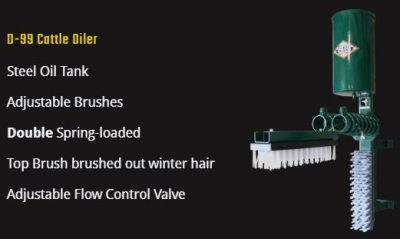
Steel-Tank Cattle Oiler Feature Diagram
The original product diagram illustrates the cattle oiler's tank, brush assembly, and liquid-delivery arrangement.
Using a Cattle Oiler for External Parasite Management
Cattle oilers are commonly used as one component of livestock grooming and external parasite management programs.
When an approved treatment is used, the animal's contact with the applicator helps distribute liquid to areas reached by the brush assembly.
Actual coverage depends on animal behavior, equipment setup, treatment formulation, and how frequently cattle use the oiler.
Important: Use only treatment products specifically labeled for the animals, application equipment, and intended use. Follow all label directions, including dilution, dosage, personal protective equipment, retreatment intervals, and meat or milk withdrawal restrictions where applicable.
A cattle oiler does not guarantee complete control of flies, lice, ticks, or other external parasites. Monitor the herd and use appropriate additional management practices when needed.
Choosing the Correct Treatment Liquid
Do not assume that every livestock insecticide, oil, or pesticide concentrate is suitable for use in a cattle oiler.
The product label must permit the intended method of application. Confirm the recommended carrier, concentration, and equipment compatibility before filling the tank.
Although the original equipment listing describes the supply line as diesel fuel-resistant, this does not establish that diesel fuel is an approved carrier for every treatment.
Use only the carrier and formulation specified by the treatment manufacturer.
Adjusting the Flow Rate
The adjustable valve allows the operator to regulate liquid delivery during brush contact.
Begin with the equipment manufacturer's instructions and the treatment label. Inspect the application area during initial use to confirm that the system is functioning as intended.
Excessive flow may waste liquid or cause unwanted dripping. Insufficient flow may prevent the treatment from reaching the intended contact surfaces.
Do not exceed labeled application rates.
Comparing Steel-Tank and Poly-Tank Cattle Oilers
Barn World offers several cattle oiler configurations. The appropriate choice depends on reservoir preference, brush design, and the installation environment.
Steel-Tank Double-Spring Cattle Oiler
This model uses a 3-gallon steel reservoir and a dual-spring top brush. It is designed for operators who prefer a steel-tank construction with adjustable grooming brushes and animal-activated liquid delivery.
Poly-Tank Cattle Oiler
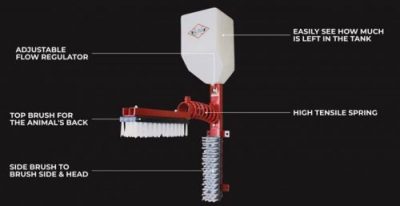
A poly-tank cattle oiler offers an alternative reservoir design. The original listing notes that its translucent tank makes it easier to view the remaining liquid level.
The following original diagram illustrates features of a similar single-spring poly-tank model. It is included for comparison and does not depict the exact steel-tank product sold on this page.
Double-Spring Poly-Tank Cattle Oiler
For customers who want the dual-spring arrangement with a translucent reservoir, Barn World also lists a double-spring poly-tank cattle oiler.
The original product photograph below shows that alternative configuration.

For other available designs, browse the cattle oiler collection.
Where to Install a Cattle Oiler
Placement is important because a self-application system depends on cattle voluntarily contacting the brushes.
Choose a location where animals naturally travel and where the equipment can be safely inspected, adjusted, and refilled.
Common Placement Considerations
- Animal traffic: Select an area cattle regularly visit so the grooming brushes are likely to be used.
- Stable installation: Follow the manufacturer's mounting requirements to prevent movement or tipping.
- Animal access: Position the brushes appropriately for the size and type of cattle using the unit.
- Inspection access: Leave sufficient space to inspect the reservoir, valve, springs, and brushes.
- Environmental protection: Avoid locations where treatment liquid could drip or spill into feed, drinking water, or drainage areas.
Do not position the equipment in a way that obstructs safe animal movement or creates a trapping or crowding hazard.
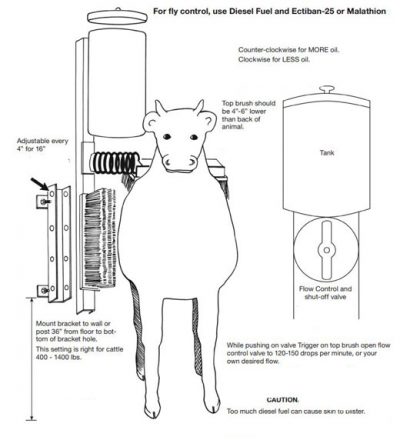
Cattle Oiler Installation and Flow-Control Diagram
The following original diagram illustrates a typical cattle oiler's operating arrangement, including its valve and liquid-delivery components.
Setting Up the Cattle Oiler
1. Inspect the Equipment
Before installation, examine the reservoir, brush assemblies, spring supports, supply line, valve, and mounting components.
Do not install damaged equipment or operate a unit with loose or missing components.
2. Secure the Oiler
Install the equipment according to the manufacturer's mounting instructions. Account for repeated pressure from cattle rubbing against the brushes.
The mounting structure must be appropriate for the forces created during normal use.
3. Adjust the Brushes
Set the brush positions for the intended animals according to the equipment instructions.
Check that cattle can make normal contact without forcing their bodies into an awkward or unsafe position.
4. Prepare the Liquid Application System
Before adding a treatment, confirm that the product label permits the intended cattle oiler application.
Follow the label's mixing, handling, and safety requirements. Avoid contamination of the reservoir and application components.
5. Test the Valve
Confirm that the pressure-sensitive mechanism opens when activated and closes when released.
Inspect the hose, fittings, and brush assembly for leakage or blocked flow.
6. Monitor Initial Use
Observe how cattle interact with the unit and verify that the brushes and liquid-delivery system function correctly.
Make adjustments only according to the manufacturer's instructions and the approved treatment label.
Maintenance and Replacement Cattle Oiler Brushes
Regular maintenance helps keep the grooming and application system functioning as intended.
Inspect the Brushes
Brushes can wear as cattle repeatedly rub against them. Check for excessive wear, loose sections, damaged mounting points, or components that could injure animals.
Barn World lists replacement cattle oiler brushes. Confirm compatibility with this double-spring steel-tank model before ordering.
Check the Springs
Inspect both upper spring assemblies for damage, deformation, or loose mounting hardware.
Do not operate the unit with damaged springs or compromised brush supports.
Inspect the Reservoir
Check the steel tank for corrosion, leakage, secure mounting, and adequate liquid level.
Use appropriate protective equipment when handling treatment products or cleaning the reservoir.
Check the Valve and Supply Line
Inspect the pressure-activated valve, adjustable flow control, and supply line for blockages, wear, and leaks.
If the valve does not close properly, stop using the liquid-delivery system until the problem is corrected.
Clean and Store Appropriately
Follow the equipment manufacturer's cleaning and seasonal storage recommendations. Dispose of unused treatment liquid and rinsate according to the product label and applicable requirements.
Cattle Oiler Replacement Parts Diagram
The original parts diagram illustrates components used in the cattle oiler assembly and can help identify items that may require maintenance or replacement.

Parts availability and compatibility should be confirmed before ordering. A diagram showing a component does not guarantee that every individual replacement part is currently sold separately.
Frequently Asked Questions
How much liquid does the steel-tank cattle oiler hold?
The listed reservoir capacity is 3 gallons.
What is the purpose of the two springs?
The double-spring assembly supports the upper grooming brush and provides resistance and movement when cattle rub against it.
How does the liquid-dispensing valve work?
The pressure-sensitive valve is designed to open when cattle engage the brush and close when contact stops. The flow rate can be adjusted according to the equipment instructions.
Does the cattle oiler continuously dispense liquid?
No. The valve is designed for animal-activated dispensing rather than continuous flow. However, wear, damage, or incorrect adjustment can cause leakage.
Can I use any insecticide in the cattle oiler?
No. Use only treatment products specifically labeled for the intended animals and application method. Follow all label instructions and restrictions.
Does the cattle oiler eliminate flies and other parasites?
No single cattle oiler guarantees complete parasite control. When used with a properly labeled treatment, it can be one component of an overall livestock parasite management program.
Can I use the brushes without applying pesticide?
The brushes provide a mechanical rubbing surface. If you intend to use the unit without liquid treatment, follow the equipment manufacturer's instructions for operating and maintaining the system in that configuration.
Can the brushes be replaced?
Barn World lists replacement cattle oiler brushes. Verify that the replacement parts match your model.
How tall is the cattle oiler?
The original product listing specifies an overall height of 5 feet.
What is the listed shipping weight?
The listed shipping weight is 90 pounds, with shipping dimensions of 12 × 12 × 60 inches. Confirm current freight details when requesting a quote.
What is the difference between steel and poly tanks?
This model uses a steel reservoir. The alternative poly-tank models have translucent reservoirs that can make the remaining liquid level easier to see. Compare the brush and spring arrangements as well as the reservoir material.
Order the Double-Spring Steel-Tank Cattle Oiler
The Double-Spring Steel-Tank Cattle Oiler combines a 3-gallon reservoir, adjustable grooming brushes, dual-spring upper brush support, and pressure-activated liquid delivery in a livestock grooming and application system.
It is intended for cattle operations seeking a stationary rubbing station that can also be used with appropriately labeled liquid treatments.
Before ordering, consider your herd size, installation location, treatment requirements, and preference for steel or poly reservoir construction.
For product availability, replacement-part questions, or a freight quote, contact Barn World at (720) 238-2190 or Sales@BarnWorld.com. Include your delivery ZIP code when requesting shipping information.
Browse additional cattle oilers and cow brushes to review other configurations.