Cattle Guard Information from Barn World

Choosing a cattle guard is more than picking a length and ordering it. The right guard depends on the vehicles crossing it, the amount of traffic, the required load rating, the width of the road or driveway, how the fence connects to the ends, and how the guard will be supported.
Barn World carries several types of cattle guards, including round and flat top rails, private-use and highway-rated designs, boxed guards, removable boxes, wings, precast foundations, and concrete cattle guard forms. Understanding the differences before ordering can help you avoid choosing a guard that is either more than you need or not suited to the site.

Start With the Traffic and Load Rating
The first question to answer is what will drive across the cattle guard. A ranch entrance used primarily by pickups, tractors, and farm equipment does not necessarily have the same requirements as a public roadway carrying heavy commercial trucks.
Barn World offers cattle guards in several load ratings:
| Rating | Load Rating | Typical Application |
|---|---|---|
| H-15 | 12 tons per axle | Private driveways, ranch entrances, and similar applications |
| H-20 / HS20 | 16 tons per axle | Public roadway and highway projects where this rating is required |
| U-54 | 25 tons per axle | Very heavy-duty applications |
| U-80 | 30 tons per axle | Extremely heavy-duty applications |
These are the load ratings currently listed by Barn World. For a public road, check the requirements of the applicable state, county, city, or other road authority before selecting a rating. A project specification may require a particular rating regardless of the vehicles you expect to see.
Flat Top or Round Top Cattle Guard?
The two main rail designs at Barn World are flat top rail cattle guards and round rail cattle guards. Both are designed to provide a livestock barrier while allowing vehicles to cross without opening a gate, but they suit somewhat different situations.
Flat Top Cattle Guards
Flat top rails provide a smoother surface for vehicle tires than round pipe. That makes them useful on roads and entrances where vehicles cross frequently or at higher speeds.
Barn World's flat rail selection includes H-15, HS20, U-54, and U-80 rated designs. The current flat rail collection offers guards in 8-, 10-, 12-, and 14-foot lengths, and multiple guards can be installed end-to-end when a wider crossing is required.

Round Rail Cattle Guards
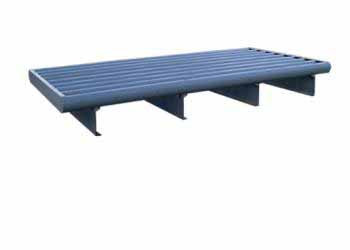
Round rail is the traditional cattle guard design. The curved top rail makes it more difficult for cattle to get secure footing, while the gaps between the rails provide the visual barrier that discourages livestock from attempting to cross.
Barn World's round rail guards are available for both private-use and highway-rated applications. Current round rail sizes range from 8 feet through 20 feet in single-span lengths, with 6- or 8-foot depths available on many models.
The round rail design also tends to produce a more noticeable ride when a vehicle crosses it. For a ranch road or driveway where traffic is slower, that may be perfectly acceptable. For a higher-speed roadway, the smoother surface of a flat rail guard may be more appropriate.
How Long and Deep Should a Cattle Guard Be?
Cattle guard dimensions are normally discussed in two directions. The length is the dimension across the roadway, while the depth runs in the direction the vehicle travels.
For example, the current 8-foot round rail cattle guard is available in 8' x 6' and 8' x 8' configurations. The 8-foot length crosses the road from one side to the other, while the 6- or 8-foot dimension determines how much of the vehicle's travel path is covered.
Wider roads can require more than one guard. Barn World's guards include options for mounting sections end-to-end, allowing the crossing to cover a roadway wider than one individual guard.
Before ordering, measure the actual road or driveway width rather than estimating from the fence opening. Also consider shoulders, drainage areas, and how the fencing will terminate at each side.
When a Boxed Cattle Guard Makes Sense
A conventional cattle guard is commonly installed over a prepared foundation or vault. A boxed cattle guard provides another option.
Barn World's boxed round rail design has a steel skirt welded around the perimeter. The skirt helps keep soil from working underneath the guard and allows the guard to be installed directly on prepared ground without a traditional concrete foundation.
This configuration is particularly useful for lower-traffic locations, remote ranch entrances, temporary installations, and other sites where pouring a permanent concrete vault does not make sense.

A level, stable surface and proper drainage are still important. Barn World recommends crushed gravel beneath boxed installations to help with drainage and erosion. The guard must also be positioned so it does not shift from its intended location.
Removable Box Cattle Guards
A removable box adds another practical feature. The guard can be lifted out of the surrounding box when the area underneath needs to be cleaned.
This can be useful at locations where dirt, mud, leaves, snow, or other debris regularly accumulates beneath the cattle guard. Instead of disturbing the surrounding installation, the grid can be removed, the area cleaned, and the guard put back into the box.
Do You Need Cattle Guard Wings?
Wings solve a common problem that has nothing to do with the center of the cattle guard. They keep livestock from simply walking around the end.
When a fence meets a cattle guard, there can be a gap around the end fence post. A determined cow does not have to cross the rails if it can walk around that opening.
Cattle guard wings create the transition from the vertical fence line down to the horizontal cattle guard. The triangular wing sections bolt to the ends of the guard and connect to wing posts and fencing.
For a cattle guard to work as part of a continuous livestock barrier, the fence-to-guard transition deserves as much attention as the guard itself.

Cattle Guard Foundations: Pour Concrete or Use Precast?
A cattle guard needs a stable support system. The foundation is not something to decide after the guard arrives.
For flat top cattle guards, Barn World offers precast cattle guard foundations. These are sold in pairs and are designed to support flat top rail guards. They include embedded J-bolts for attaching the guard.
The current precast foundations are available for 8-, 10-, 12-, and 14-foot flat top guards. They are extremely heavy. The 8-foot pair weighs approximately 2,000 pounds, while the 14-foot foundations weigh about 3,500 pounds, so mechanical unloading must be arranged before delivery.
Site conditions also matter. Soil, drainage, frost depth, and the amount of traffic should be considered when determining the appropriate installation. Barn World recommends consulting a qualified local contractor familiar with the site.

Another Option: Pour Your Own Concrete Cattle Guard
Some installations call for a permanent concrete vault rather than a steel foundation system. Barn World also carries concrete cattle guard forms for customers who want to pour their own finished crossing.
There are currently reusable and in-ground form options. A reusable form can be used for multiple projects, while the larger one-piece design remains in the ground after the concrete is poured.
This approach gives the installer more control over the finished concrete installation, but it also means the site needs to be prepared for excavation, drainage, reinforcement, concrete placement, and curing.
What About HS20 Cattle Guards?
If the cattle guard will be installed on a public road or a project with a specified roadway load rating, the rating becomes one of the most important purchasing decisions.
Barn World's current HS20 cattle guards are rated at 16 tons per axle. The current flat-top HS20 collection includes 8-, 10-, 12-, and 14-foot guards. The guards have pre-drilled holes for mounting sections end-to-end when additional roadway width is needed.
For a public project, don't select an HS20 guard simply because the number sounds appropriate. Check the project specifications and the requirements of the agency responsible for the road. Different jurisdictions and projects can have specific requirements for load rating, dimensions, foundations, engineering, or installation.
How Much Traffic Will Cross the Guard?
Traffic frequency is another useful way to narrow the choices.
| Site | Things to Consider |
|---|---|
| Private ranch entrance | Load rating, livestock containment, road width, foundation |
| Farm driveway | Vehicle types, traffic frequency, rail design, drainage |
| Remote pasture road | Boxed design, drainage, ease of installation and maintenance |
| Public roadway | Required load rating, agency specifications, foundation, rail design |
| Wide commercial entrance | Multiple sections, end-to-end mounting, traffic load, foundation |
Cleaning Under a Cattle Guard
The space beneath a cattle guard is part of the livestock-deterrent design. If it gradually fills with dirt and debris, the open space between the rails can become less effective.
Regular inspection is especially worthwhile after heavy rain, snow, flooding, or periods when the roadway carries mud onto the crossing.
Barn World offers guards with optional hinged clean-out sections. These sections provide access to the area underneath without requiring the entire guard to be removed.
A removable-box cattle guard provides another approach when frequent cleaning is expected. The grid can be lifted from the surrounding box, the area beneath it cleaned, and the grid returned to its position.
Cattle Guard Installation: What to Plan Before Delivery
The installation method depends on the cattle guard you choose. Before ordering, make sure the site and equipment are ready for the particular design.
- Measure the roadway: Determine the actual crossing width and the required depth in the direction of travel.
- Identify the vehicles: Consider pickups, tractors, trailers, loaded trucks, and other equipment that will cross the guard.
- Determine the required load rating: Private property and public roadway projects may have different requirements.
- Choose the rail design: Flat rails provide a smoother vehicle crossing, while round rails provide the traditional round-pipe design.
- Plan the foundation: Decide whether the project calls for a concrete vault, precast foundations, or a boxed installation.
- Plan drainage: Water should not be allowed to undermine the installation or continually wash material into the cattle guard.
- Connect the fence: Include wings when needed to prevent livestock from walking around the ends.
- Plan unloading: Cattle guards and especially precast foundations are heavy. Make sure the required unloading equipment is available.
Which Cattle Guard Fits Your Application?
| If You Need... | Look At... |
|---|---|
| A private ranch or driveway crossing | H-15 cattle guards |
| A smoother crossing for frequent vehicle traffic | Flat top cattle guards |
| A traditional aggressive round-pipe design | Round rail cattle guards |
| A public roadway or specified 16-ton-per-axle rating | HS20 cattle guards |
| A guard that can sit directly on prepared ground | Boxed cattle guards |
| A fence-to-guard connection | Cattle guard wings |
| A ready-made foundation for a flat top guard | Precast cattle guard foundations |
| A custom poured concrete crossing | Concrete cattle guard forms |
Don't Choose a Cattle Guard by Price Alone
The least expensive cattle guard is not necessarily the right one for the site. A lower-cost private-use guard may be appropriate for a ranch driveway, while a roadway project may require a specific load rating. A boxed design may save the work of pouring a foundation at a remote location, while a heavily traveled entrance may justify a more permanent installation.
The cost of the complete project also includes foundations, wings, delivery, unloading, site preparation, and installation. Comparing the complete installation rather than just the price of the steel grid gives you a much better picture of what the project will require.
Cattle Guard FAQs
What is the difference between a flat and round cattle guard?
Flat top rails provide a smoother surface for vehicle tires and are commonly used where vehicle traffic is frequent or faster. Round top rails are the traditional cattle guard design and provide a more noticeable rumble when vehicles cross.
What cattle guard rating do I need?
That depends on the vehicles and the requirements of the site. Barn World currently lists H-15 at 12 tons per axle, HS20 at 16 tons per axle, U-54 at 25 tons per axle, and U-80 at 30 tons per axle. Public roadway projects should be checked against the applicable agency requirements.
Can a cattle guard be installed without concrete?
Some designs can. Barn World's boxed cattle guards are designed to sit directly on prepared ground and are commonly used in lower-traffic, remote, or temporary applications. Proper ground preparation and drainage are still important.
What are cattle guard wings for?
Wings connect the fence line to the ends of the cattle guard and prevent livestock from walking around the side of the guard instead of crossing it.
How wide are cattle guards?
Widths vary by model. Barn World's round rail guards are available in several lengths, including 8, 10, 12, 14, 16, 18, and 20 feet. Multiple sections can also be used together for wider crossings.
Can two cattle guards be installed together?
Yes. Barn World's guards include designs that can be mounted end-to-end when additional roadway width is required.
Do cattle guards need a foundation?
Not every design does. Boxed cattle guards can be installed directly on prepared ground, while other guards can be installed with concrete foundations. Flat top guards are also available with precast concrete foundations.
How do I keep dirt from filling under a cattle guard?
Good drainage and proper site preparation are important. Some Barn World guards are available with integral or removable boxes that help control soil around the installation. Hinged clean-out sections are also available on certain guards.
Can I pour my own cattle guard foundation?
Yes. Barn World offers concrete cattle guard forms for customers who want to create their own concrete crossing. A reusable form can be used for multiple installations, while another design remains in the ground after the concrete is poured.
Choose the Cattle Guard Around the Site, Not the Other Way Around
A cattle guard works best when the guard, road, fence, foundation, and traffic requirements are considered as one installation. Start with the vehicles that will cross it and the load rating the site requires. Then choose between flat and round rails, determine the appropriate length and depth, and decide how the guard will be supported.
Don't overlook the ends of the crossing. Wings can close the gap between the fence and guard, while the right foundation or boxed design can make a major difference in how the installation handles soil, drainage, traffic, and maintenance.
If you're unsure which cattle guard fits your road, driveway, ranch entrance, or public-road project, Barn World can help you compare the available sizes, ratings, rail designs, wings, and foundation options before you order.