HS20 Cattle Guards for Public Roads: What You Need to Know
When a cattle guard will be installed on a public road, highway, or other regulated roadway, choosing a private-use cattle guard may not be enough. The crossing needs to be designed and rated for the vehicle loads it will carry.
Barn World offers HS20 cattle guards engineered for public roadway applications. The current selection includes flat-top and round-top designs in several sizes, along with options for wings and foundations.

What Is an HS20 Cattle Guard?
HS20 is an engineered load rating used for heavy vehicle crossings. Barn World's HS20 cattle guards are rated for 16 tons per axle and are intended for public roadway applications where an engineered load rating is required.
The rating is not simply a measurement of how much steel is in the cattle guard. The design, supporting structure, dimensions, materials, and expected vehicle loading all factor into the engineering of the crossing.
Barn World's rated cattle guards are supplied with an engineer's stamp and are designed to conform to the applicable AASHTO load-rating requirements.
Why Public Roads Require a Rated Cattle Guard
A cattle guard on a private ranch driveway does not necessarily have the same requirements as one installed in a public roadway. Public roads may carry passenger vehicles, loaded trucks, emergency vehicles, construction equipment, and other heavy traffic.
For that reason, the required load rating should be determined before ordering a cattle guard for a public project. Local and state requirements should also be confirmed with the agency responsible for the roadway.
Barn World's HS20 designs provide a 16-ton-per-axle engineered rating for projects where that level of capacity is required.
HS20 Cattle Guard Load Ratings
AASHTO load classifications include several different levels of vehicle loading. Barn World lists the following ratings for cattle guards:
| Rating | Load Per Axle | Typical Application |
|---|---|---|
| H-15 | 12 tons | Lower-rated applications |
| H-20 / HS20 | 16 tons | Public roadway and highway applications |
| U-54 | 25 tons | Higher-load applications |
| U-80 | 30 tons | Very heavy-load applications |
The required rating should always be confirmed for the specific roadway project rather than assuming that HS20 is appropriate for every location.
Flat-Top vs. Round-Top HS20 Cattle Guards
Barn World offers HS20 cattle guards with both flat and round top rails. The choice affects how vehicles cross the guard as well as the physical design of the livestock barrier.
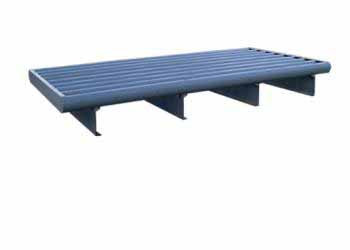
Flat-top cattle guards have a flatter upper surface that provides a smoother crossing for vehicles. Barn World's current HS20 flat-rail collection includes several lengths and is designed for public roadway applications.
Round-top cattle guards use round steel rails. The rounded rail creates an unstable surface for livestock while still supporting the rated vehicle load. Barn World offers round-top cattle guards in both private-use and HS20-rated configurations.
Choosing the Right Cattle Guard Length and Depth
Two dimensions are particularly important when ordering a cattle guard: the length across the roadway and the depth in the direction of vehicle travel.
Barn World offers cattle guards in a range of lengths. Current HS20 flat-top models include 8-, 10-, 12-, and 14-foot lengths. Round-top models are available in additional lengths, including larger single-span designs.
The depth of the cattle guard is typically 6 or 8 feet. If a project requires more width or depth than one guard provides, multiple sections can be connected according to the design of the particular model.
Before ordering, measure the roadway carefully and determine whether the project calls for one crossing or multiple cattle guards connected.
Round Rail Cattle Guards for Public Roadways
Barn World's round-top cattle guards are available with an HS20 rating as well as lower-rated private-use configurations. The HS20 versions use engineered load-carrying components to provide the 16-ton-per-axle rating required for applicable public roadway projects.
The current 12-foot round-top model, for example, is available in 6- and 8-foot depths and uses 3.5-inch outside-diameter top rails. The guard is fully welded, uses 8-inch load-carrying channel beams, and has approximately 3.11 inches between the rail walls.
Round-top designs are also available in longer lengths, including 14-, 16-, and 20-foot models.
Flat-Top HS20 Cattle Guards
Flat-top designs are useful when vehicle crossing characteristics are an important consideration. The flat upper surface provides a smoother transition for vehicles than a round rail.
Barn World's current 10-foot HS20 flat-top cattle guard is rated at 16 tons per axle and uses two 8-inch C-channel supports for transferring vehicle loads to the ground. It is available in 7.5- and 8-foot depths.

The flat-top design is also available with optional hinged clean-out sections and precast foundations. These options can simplify maintenance and installation depending on the project.
Cattle Guard Wings Keep Livestock From Going Around the Ends
A cattle guard only works as a complete livestock barrier if the fence connects properly to the crossing. Without an appropriate transition at the ends, cattle may be able to walk around the guard rather than crossing it.
Barn World offers cattle guard wings that connect the fence line to the ends of the cattle guard. The triangular wing sections extend outward from the guard and provide a continuous physical barrier between the fence and the crossing.
Wing dimensions need to match the cattle guard being installed, so verify the appropriate size before ordering.

Cattle Guard Foundations
A properly designed foundation is an important part of any permanent cattle guard installation. The steel crossing can be engineered to carry heavy loads, but those loads still need to be transferred safely into the ground.
Barn World offers precast cattle guard foundations that can be shipped with applicable guards. These foundations are designed to provide a ready-made support system rather than requiring the entire concrete footing to be formed and poured on site.
Local soil conditions, drainage, frost depth, roadway requirements, and other site conditions should be considered when determining the appropriate foundation and installation method.

Connecting Cattle Guards End-to-End or Side-by-Side
Not every roadway can be covered by one cattle guard. Depending on the required dimensions, multiple sections can be connected.
Barn World's cattle guard designs include options for connecting sections end-to-end or side-by-side. End-to-end connections can provide additional length across a wide roadway, while side-by-side placement can increase the distance in the direction of vehicle travel.
The exact connection method and hardware should be confirmed for the specific cattle guard model being installed.
Why the Foundation and Drainage Matter
Water management should be considered before installing a cattle guard. Standing water beneath or around the crossing can create problems with the surrounding soil and installation.
For permanent installations, the foundation should be designed around the site's drainage and soil conditions. Barn World's boxed cattle guards are another option for certain lower-traffic or remote applications because they can be installed directly on prepared ground rather than requiring a conventional poured footing.
Even with a boxed design, the installation needs a stable, level surface and adequate drainage.
HS20 Cattle Guards vs. Private-Use Cattle Guards
One of the most important decisions is determining whether the project requires an engineered roadway rating.
| Feature | HS20 Rated | Private Use |
|---|---|---|
| Engineered rating | 16 tons per axle | Lower-cost private-use design |
| Public roadway use | Designed for applicable public roadway projects | Not an engineered HS20 roadway rating |
| Typical application | Public roads and regulated crossings | Private driveways, ranches, and farms |
| Engineering documentation | Engineer-rated and stamped | Not supplied as an HS20-certified design |
Do not select a private-use cattle guard simply because it appears physically similar to a rated model. If a public agency requires an engineered rating, the specific rated design and documentation should be used.
What to Know Before Ordering an HS20 Cattle Guard
Because cattle guards are large, heavy structures, getting the project dimensions right before ordering is important. Have the following information available:
- Required load rating: Confirm whether HS20 or another rating is required.
- Roadway width: Measure the distance the crossing must span.
- Direction of travel: Determine whether the crossing should be 6 or 8 feet deep or require a different configuration.
- Rail style: Decide whether a flat or round top rail is appropriate for the project.
- Foundation: Determine whether the site will use poured concrete, precast foundations, or a boxed design where applicable.
- Fence connection: Determine whether wings are needed to connect the crossing to the existing fence.
- Delivery: Make sure there is equipment available to unload a large, heavy cattle guard from the delivery vehicle.
- Local requirements: Confirm roadway specifications with the responsible city, county, state, or other agency.
HS20 Cattle Guard FAQs
What is the HS20 rating on a cattle guard?
An HS20 cattle guard is an engineered design rated for 16 tons per axle. Barn World offers HS20-rated cattle guards for public roadway and highway applications.
Are HS20 cattle guards required for public roads?
Public roadway projects can have specific load-rating requirements established by the responsible transportation agency. Barn World identifies HS20 as the 16-ton-per-axle rating used for applicable public roadway projects. Always confirm the requirement with the agency responsible for your specific road.
What is the difference between a round and flat cattle guard?
Round-top cattle guards use round steel rails and provide an uneven surface for livestock. Flat-top cattle guards have a flatter upper rail surface and provide a smoother vehicle crossing.
What sizes do HS20 cattle guards come in?
Barn World offers HS20 cattle guards in multiple lengths and depths. Current flat-top HS20 models include 8-, 10-, 12-, and 14-foot lengths, while round-top HS20 models are available in additional lengths, including 20-foot single-span designs.
Can cattle guard sections be connected?
Yes. Depending on the model, cattle guards can be configured for end-to-end or side-by-side installation when a project requires additional length or depth.
Do cattle guards need wings?
Wings are used to connect the cattle guard to the fence line and prevent livestock from walking around the ends of the crossing. The appropriate wing size depends on the cattle guard dimensions.
Can I get foundations with an HS20 cattle guard?
Yes. Barn World offers precast cattle guard foundations for applicable installations. Foundation requirements should be determined based on the site, soil, drainage, frost conditions, and project requirements.
How is an HS20 cattle guard delivered?
Cattle guards are large and heavy, and delivery requires planning. Barn World notes that customers receiving large one-piece guards need to provide a means of unloading the guard from the delivery vehicle.
Choosing an HS20 Cattle Guard for Your Project
An HS20 cattle guard is only one part of a successful roadway crossing. The load rating, guard dimensions, rail style, foundation, drainage, fence connection, and local roadway requirements all need to work together.
Barn World can help you compare HS20 cattle guards, determine which size and rail style fits your project, and coordinate options such as cattle guard wings and foundations. If you have the roadway dimensions and the required load rating, Barn World can help you put together the appropriate cattle guard configuration and provide a quote with shipping.