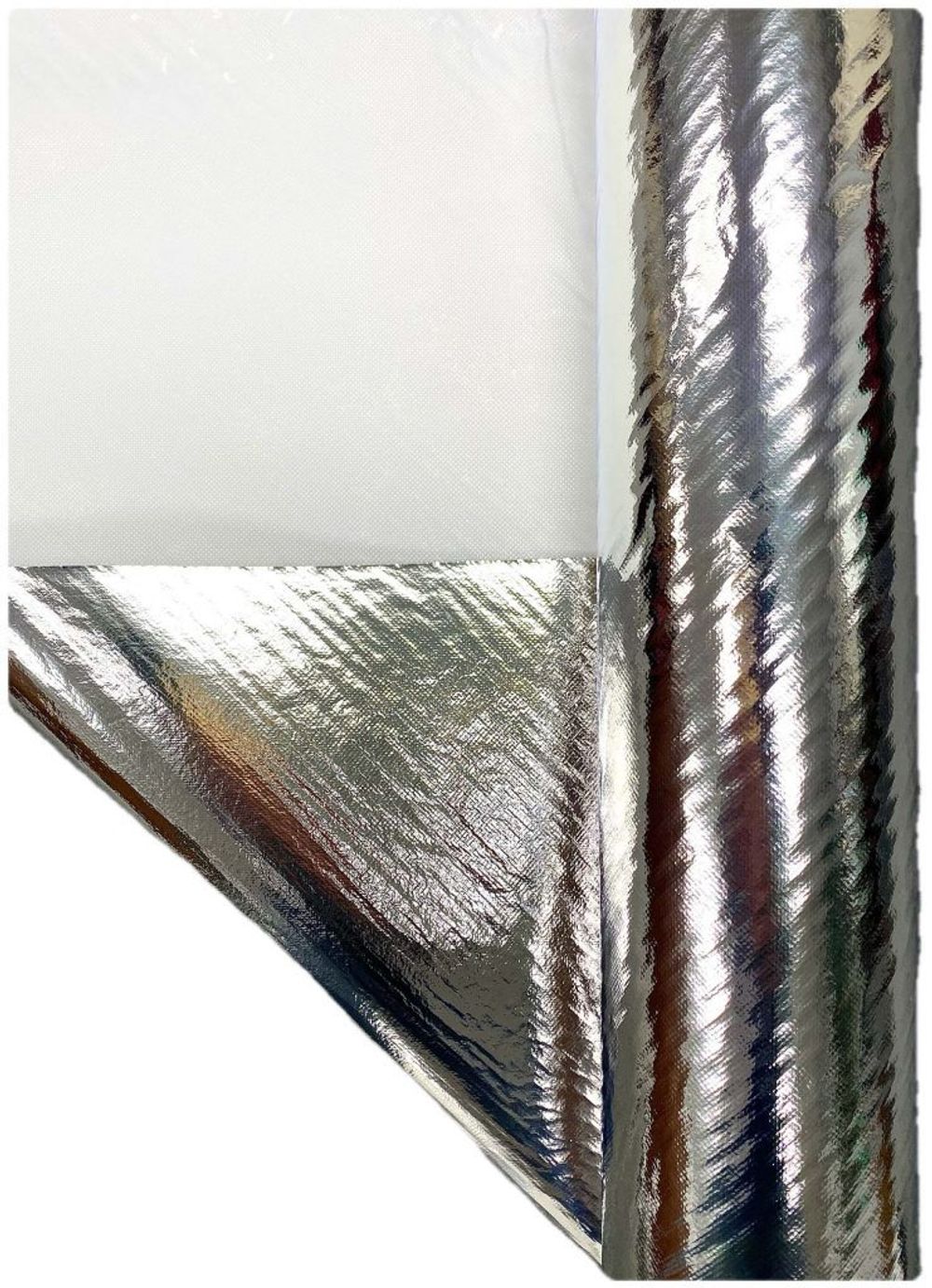

This very versatile heat-reflecting fabric is also quite durable. It is made with a patent-pending, polypropylene-based, non-woven, perforated fabric with aluminum on one side. The reflective aluminum film is a very thin coating that has tiny pinholes to allow it to breathe so it won't trap moisture. Because of this, the fabric is not waterproof, and it is not designed to be exposed to the elements, but rather to be an integral part of your heat shield or reflective barrier system.
It reflects 95% of the radiant heat, the major source of heat transfer, and with this technology, it will retain or reflect heat, thereby remaining warmer or cooler as desired. It may be washed by hand or machine-washed with a gentle cycle and is easily used in traditional sewing machines. It will work wonderfully in a tent, but it is applied on the interior with the aluminum side facing out. That allows it to block the incoming radiant heat and will not allow the heat striking the tent to emit downward into the air space below.
Other fabrics only absorb heat, delaying it before it reaches you. Temptrol is the only fabric that acts as a radiant barrier to reflect heat. Each standard roll is 59" wide and is available in any custom length when ordered in lengths over 20 yards. We also carry the Temptrol I for a less shiny or metalized finish. You can see the comparison pictures below.
Temptrol I vs Temptrol II


Benefits of Heat-Reflecting Fabric
- Temperature Comfort
- Breathable
- 90% heat reflective
- Lightweight and easy to handle
- Easy to sew with standard equipment
- Clean and Dry; Does not promote the growth of fungi or bacteria
- Shielding against electromagnetic and radio frequency interference
- Solar protection
- Flexes without cracking
- Infrared shielding
- Non-toxic and non-carcinogenic
Pictures of typical uses


How Radiant Barriers Work
The radiant-insulated fabric has many uses and can be adapted to provide insulating qualities almost anywhere. See the following descriptions for some of the common uses and incredible properties of this fabric.
Be sure to check out all of our insulation products too!
An Introduction to a Radiant Barrier Foil Insulation
It can be hard to wrap your head around how a thin sheet of reflective material resembling kitchen foil can make such a big difference in blocking heat transfer, but that's exactly how a radiant barrier works. This post is intended to summarize and explain the science behind a radiant barrier in a simple, easy-to-understand way.
To understand how a radiant barrier works, you first have to understand the three different types of heat transfer. The three modes of heat transfer are conduction, convection, and radiation.
Conduction is the direct heat flow through a solid object, like a wall or ceiling.
Convection is heat movement through the air, occurring when air is warmed. The warm air expands, becoming less dense, and rises.
Radiant heat transfers the movement of heat rays across air spaces from one warm object to another cooler object. The heat you feel from a campfire is radiant heat. This is the most dominant form of heat transfer.
Technology shows us that different types of heat contribute to the transfer of heat into and out of your home, but radiant heat accounts for the largest percentage of heat loss or gain, no matter the climate or season, making it by far the most dominant contributor.
Traditional forms of insulation like fiberglass, cellulose, and foam only work to absorb and slow down conductive and convective heat. They absorb heat much the same way that a sponge absorbs water. But just as a sponge filled with water can no longer hold any more water, with every new drop that hits it, another drips out the other side. Insulation works the same way. As it becomes saturated with heat and can’t hold any more, the insulation becomes inefficient. A single sheet of radiant barrier, on the other hand, reflects the radiant or infrared heatwaves instead of absorbing them the way other insulation does. This radiant heat barrier reflects 95% of radiant heat. That’s why a radiant barrier is called a barrier because it simply blocks the heat.
The reason the radiant barrier is so effective at blocking radiant heat is that it has a very low emissivity rate. Emissivity is the ability of a material to emit radiant energy. Most common building materials — brick, stone, wood, etc. – have very high emissivity rates, and in turn, they absorb large amounts of radiant energy and emit 80% to 90% of this energy to the spaces around them. Radiant barrier foil insulation, because it has a very low emissivity rate of 3% to 5%, absorbs and emits a very small amount of energy. More simply put, radiant heat passes through these objects at a much higher rate than a radiant barrier.
Here is a table comparing the emissivity rates of common building materials to those of radiant barrier foil insulation.
| Material | Emissivity |
|---|---|
| Wood | 95% |
| Glass | 94% |
| Brick (common red) | 93% |
| Concrete | 92% |
| Steel | 45% |
| Radiant Barrier (Aluminum) | 3-5% |
Also, radiant barrier insulation will never need to be replaced. It is made up of coated aluminum, so it will never break down due to UV or corrosion. Other insulations rely on their mass to remain effective, meaning that as they settle and flatten, they become much less efficient and need to be replaced. A radiant barrier doesn’t settle or flatten the way other insulation can, and doesn’t rely on thickness or mass to work. Radiant barriers can provide a lifetime of energy-saving benefits.
The benefits of radiant barriers
- Reduces your heating and cooling costs
- Easy and inexpensive to install
- Pays for itself
- Makes you money with continued savings
- Maintains comfortable temperature
- Conserves valuable energy
Attic Insulation Video
VIDEO: How Aluminum Insulation works
Here is an old but great video explaining how radiant barrier insulation works in the home and in a variety of other applications.
Product Specifications |
|
|---|---|
| PRODUCT: | Polypropylene-based non-woven perforated and has aluminum on one side |
| WEIGHT: | 17.3 lb M/sf (pounds per 1,000 sf) |
| NOMINAL THICKNESS: | 10.9 mils |
| TENSILE STRENGTH: | 47.0 lb/in width* |
| TEAR STRENGTH: | 6.0 lb/in width* |
| PUNCTURE RESISTANCE: | 17 lbs.** |
| MULLEN BURST STRENGTH: | 55.0 psi* |
| LOW-TEMPERATURE BEND: | 131° F PASS*** |
| WATER VAPOR PERMEABILITY: | 87.5g/m2/24hr**** |
| FLAMMABILITY: | Class B***** |
| THERMAL PROPERTIES: | Emissivity 0.05****** (Reflects 95% of Infrared Energy) |
Residential Applications:
New Construction and Remodeling:
Draped over rafters before roof decking is applied for new construction
Stud Wall cavities
House Wrap
Cathedral / Vaulted Ceilings
Crawlspaces / Basements
Garages / Workshops / Bonus Rooms
Wood or Metal Frame Buildings / Concrete Block
Single and Multi-family units
Retrofit:
Stapled to bottom chord of rafters or placed on top of mass insulation for existing homes
Basement / Crawlspace / Garage / Workshops
Playhouses / Dog Houses
Water Heaters
Carpet Pad
Commercial:
New and Retrofit Applications:
Metal Buildings
Warehouses
Office Buildings
Plants
Self Storage Units
Overhead & Roll-Up Doors
Industrial:
Boilers
Pipes
Tanks
Heat Shields
Laboratories
Agricultural:
Pole Barns / Post Frame Construction
Incubators / Chicken Coops
Livestock Trailers
Metal Buildings
Shipping:
Protects temperature-sensitive cargo: (candy, cigarettes, fruit, vegetables, meat, ice cream, dairy, pharmaceuticals, coffee)
Reefers / Railroad cars
Thermal Bags
Box Liners
Shipping Containers
Food Service:
Freezer / Coolers
Ovens
Delivery Bags
Packaged Food Wrap
Transportation
Commercial Kitchens
Automotive / RV:
Headliners / Door Panels / Firewall
Conversion Vans
RV
Sunshields
OEM:
Spas / Saunas
Canvas Buildings
Modular Buildings
Heat Shields
Coolers / Food Service Bags
Also:
Aviation
Survival Gear
Export
Award-Winning New Product
Temptrol is an innovative, lightweight, and flexible material that has earned the prestigious AIMCAL* Technical Award in the Industrial Category for 2005. The judges observed that the innovative application moves to metalize into new markets and advances its usage. Be among the first to experience the versatility of this new material.
*AIMCAL, Association of Industrial Metallizers, Coaters, and Laminators, is an international nonprofit trade association headquartered in Fort Mill, South Carolina, USA. It represents converters of laminated, coated, or metalized flexible substrates and their suppliers.
Key Benefits of Temptrol
- Greater comfort
- Breathable
- Puncture and tear-resistant
- 95% reflectivity
- Lightweight and easy to handle
- Easy to sew with standard equipment
- Does not promote the growth of fungi or bacteria
- Shielding against electromagnetic and radio frequency interference
- Solar protection
- Thermal management
- Flexes without cracking
- Infrared shielding
- Non-toxic/non-carcinogenic
Suggested Foil Insulation Applications
- Jackets
- Caps
- Gloves
- Pants
- Parkas
- Boot liners
- Comforters
- Blankets
- Draperies
- Grocery Totes
- Pizza Bags
- Sleeping Bags
- Tents
- Tarps
- Awnings
- Canapies
- Solar Screens
- Grill Covers
- Wheel Covers
- Car and Boat Covers
- Snow Mobile Covers
- Athletic Field Covers
- Ground Covers
- Roofing Covers
- Temporary Shelter Covers
- Grain & Hay Bale Covers
- Firewood Covers
- Excavation Covers
- Nursery Covers
- Golf Green Covers
- Golf Cart Covers
- Machinery Covers
- Containment Tarps
SPECIFICATIONS:
Weight: 17.3 lb M/sf
Nominal thickness: 10.9 mils
Tensile strength: 47.0 lb/in width*
Tear strength: 6.0 lb/in width*
Puncture resistance: 17 lbs.**
Mullen burst strength: 55.0 psi*
Low temperature bend: 131 ° F PASS***
Water vapor permeability: 87.5g/m2/24hr****
Flammability: Class B*****
Thermal properties: Emissivity 0.08******
(Reflects 95% of Infrared Energy)
UNITED STATES TESTING COMPANY. INC.
* ASTM Test Method D751
** ASTM Test Method 4833
*** ASTM D2136
**** ASTM E96
***** ASTM E84-94
****** ASTM E408
How Radiant Barrier Insulation Helps Keep You Warm in Winter
Heat transfer, poor insulation, and heat loss. These are all concepts that homeowners who want to save money should learn more about. The fact is that more heat leaves the home through the attic than most people realize. But the good news is that addressing the problem with Radiant Barrier insulation saves energy and money.
One of the laws of thermodynamics states that heat transfers from warm to cool. Do you think you are cooling your lemonade with those ice cubes? Think again. The heat content inside the glass automatically transfers to the ice because it is colder. It is accurate to say that the lemonade heats the ice. The result of the transfer is a cool, refreshing drink. There are three methods of heat transfer:
- Conduction
- Convection
- Radiation
Conduction occurs when heat travels from one molecule to another. An example is a heating element. Good conductors of heat are usually also good conductors of electricity.
Convection is a heat transfer facilitated by the flow of air. Warm air is lighter, so it naturally moves up. The cold air weighs more; it travels down.
Radiation is the method by which heat transfers from one object to another by moving through space. The heat you feel when standing near a campfire is an example of radiation.
The warm air in your home rises to the highest point. Poor insulation allows heat to transfer through the attic to the outdoors. A radiant barrier is a reflective insulation that prevents this transfer by radiating heat back to the living space. This increases the efficiency of furnaces of all makes and models.
The reflective insulation rests on the existing insulation. It is easy to install, and homeowners notice a difference immediately. One homeowner in Texas said, “My bill went from $400 to $200!”
Give your heating system a break. Try Radiant Barrier and find out why it is so popular. Then use the extra money for something besides keeping your house warm.