


H-15 load rating: Powder River publishes 12 tons per axle for this model. Verify actual vehicle axle loads, foundation details, and any required project or roadway approvals using the exact guard's documentation. Compare available lengths and request a delivered freight quote with your ZIP code.
Please call or email Sales@BarnWorld.com for a quote with shipping.
SHOP ALL OF OUR CATTLE GUARDS
This 12-foot H-15 cattle guard is a heavy-duty flat-rail steel crossing designed for livestock containment at suitable ranch entrances, agricultural roads and other vehicle access points. Its published H-15 rating is 12 tons per axle, and its powder-coated steel construction includes eight 8-inch C-channel support members beneath the crossing surface.
The 12-foot dimension runs across the roadway, providing a wider crossing than shorter H-15 models. Optional steel wings and precast concrete foundations are available to help integrate the cattle guard with adjoining fencing and the required support arrangement.
Explore Barn World's H-15 cattle guards for additional available lengths.
12-Foot Flat-Rail Cattle Guard for Ranch Roads
A cattle guard allows suitable vehicles to pass through a livestock fence line without requiring the driver to stop and open a conventional gate during each crossing.
The steel rails create a vehicle crossing surface while forming a physical and visual deterrent to many livestock animals.
This model is intended for installations where the roadway dimensions, vehicle loads and foundation requirements are compatible with the manufacturer's specifications.
Before ordering, confirm the full guard dimensions, vehicle wheel paths, travel-direction depth and installation requirements.
12-Foot H-15 Cattle Guard Specifications
| H-15 Flat-Rail Cattle Guard | |
|---|---|
| Published Rating | H-15 |
| Published Axle Capacity | 12 tons per axle |
| Roadway Span | 12 feet |
| Rail Profile | Flat-top steel rails |
| Support Members | Eight 8-inch C-channels |
| Finish | Powder coated |
| End Connections | Pre-drilled holes for compatible adjoining sections |
| Optional Equipment | Steel wings and precast concrete footings |
| Typical Applications | Suitable agricultural and private-road crossings |
Important: The published axle rating must be matched to actual vehicle loads, axle configuration, foundation conditions and any applicable engineering or roadway requirements. Do not increase the published capacity by an assumed safety factor.
Understanding the H-15 Load Rating
The manufacturer publishes a load rating of 12 tons per axle for this H-15 cattle guard.
This rating is an important starting point when evaluating the crossing for pickup trucks, trailers, agricultural machinery and other vehicles.
However, the designation alone does not establish suitability for every vehicle or installation.
Axle spacing, axle loads, foundation design, roadway conditions and project requirements must also be considered.
Where public-road or engineered project specifications apply, obtain the required approval before installation.
Why Choose a 12-Foot Crossing?
The 12-foot roadway span provides additional width compared with shorter H-15 cattle guards.
That can be useful where the road opening, vehicle wheel paths or approach geometry require a wider crossing.
However, a wider guard is not automatically suitable for every vehicle.
Measure the intended crossing and account for trucks, trailers and equipment that may approach at an angle.
The guard's travel-direction depth and overall installation dimensions should be confirmed from the current manufacturer documentation.
Flat-Top Rails and Vehicle Travel
This cattle guard uses flat-top steel rails rather than round-top rails.
The original product description identifies the flat rail design as providing a smoother crossing surface relative to round rails.
Actual vehicle ride quality depends on the guard design, installation and operating speed.
For different rail configurations, explore Barn World's round-rail cattle guards.
How a Cattle Guard Helps Contain Livestock
The spaces between cattle guard rails create a physical and visual obstacle at a fence-line opening.
Many cattle avoid crossing these openings, allowing vehicles to use the roadway without a conventional gate at every passage.
Effectiveness varies with livestock species, behavior and installation conditions.
A cattle guard is not a guaranteed barrier for every animal. Smaller livestock and animals capable of jumping or navigating the rails may require additional containment measures.
Proper fence connections are also necessary to prevent livestock from walking around the ends.
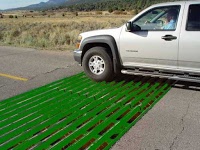
Truck Crossing a Steel Cattle Guard

Passenger Vehicle Crossing
Cattle Guard Rails and Installation
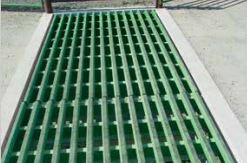
Complete Cattle Guard Installation

Eight C-Channel Support Members
The original specifications identify eight 8-inch C-channel members supporting the cattle guard.
These structural components transfer vehicle loads through the assembly to the supporting foundations.
Proper support and anchoring are essential to the crossing's performance.
Confirm the exact bearing locations, foundation details and installation requirements from the manufacturer's current documentation.
Powder-Coated Steel Construction
The original listing identifies a powder-coated finish.
This finish provides a protective coating on the steel components.
Like other outdoor steel equipment, the guard should be inspected periodically for coating damage, corrosion and structural wear.
Maintenance needs depend on traffic, climate, drainage and environmental exposure.
Optional Precast Concrete Foundations
Precast concrete footings can simplify part of the installation process by reducing the need to construct and pour foundation forms at the job site.
The original product description identifies compatible foundations with embedded 3/4-inch J-bolts.
These bolts are intended to align with the guard's mounting arrangement so the steel grid can be secured in position.
Foundation compatibility must be confirmed for the exact cattle guard before ordering.
Precast components do not eliminate the need for excavation, correct positioning, suitable bearing support or drainage.
Browse Barn World's cattle guard wings and foundations for related installation equipment.
Precast Concrete Cattle Guard Foundations
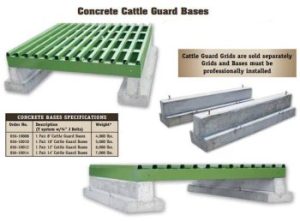
Cattle Guard Foundation Specification Illustration

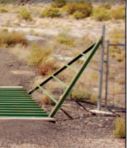
Steel Wings for Fence-Line Connections
Steel cattle guard wings help connect the crossing to the adjoining livestock fence.
Without a suitable connection, animals may be able to walk around the end of the guard.
The original description identifies wings attached to the grid and supported by end posts.
These components provide a connection point for fencing and help complete the livestock barrier.
See Barn World's cattle guard wing ends for additional product details.
Cattle Guard Wing and Post
Connecting Multiple Cattle Guard Sections
The original product description states that flat-rail guards have pre-drilled end holes for connecting compatible sections across wider roadway openings.
This may be useful where a single crossing section does not provide the required total span.
However, connecting sections must be approved for the intended configuration.
Confirm the exact joining hardware, support requirements and manufacturer-approved arrangement before ordering or installing multiple units.
H-15 Versus H-20 Cattle Guards
Choosing between H-15 and H-20 cattle guards begins with the load requirements of the intended crossing.
The H-15 model described here carries a published rating of 12 tons per axle.
Barn World also offers H-20 cattle guards with a published rating of 16 tons per axle for appropriately specified applications.
Neither designation should be selected solely by the type of vehicle expected to use the road.
Actual axle loads and project requirements must be evaluated.
For heavier-rated options, review the H-20 cattle guard collection.
Installation Planning Checklist
Before purchasing the cattle guard, review the complete installation requirements.
- Roadway dimensions: Measure the crossing width and approaches.
- Vehicle loading: Verify actual axle loads and the required rating.
- Foundation support: Confirm soil conditions and the required bearing arrangement.
- Drainage: Plan for water movement beneath and around the crossing.
- Fence connections: Determine whether wings and posts are required.
- Anchoring: Review the approved mounting arrangement.
- Access: Consider future cleaning and maintenance beneath the grid.
- Freight unloading: Arrange suitable equipment for the heavy steel assembly.
- Approvals: Obtain any required engineering or roadway authorization.
Maintaining the Cattle Guard
Regular inspection helps identify problems that may affect the crossing.
- Inspect rails and structural support members.
- Check the condition of foundations and mounting hardware.
- Remove accumulated debris beneath the grid.
- Maintain drainage around the crossing.
- Inspect wing connections and adjoining fencing.
- Check for coating damage and corrosion.
- Investigate unusual movement or settlement.
Damaged or unstable crossings should be evaluated before continued heavy vehicle use.
Ordering and Freight Delivery
Cattle guards are substantial steel freight items that require delivery planning.
When requesting a quote, provide the delivery ZIP code, quantity, required accessories and any site-access restrictions.
Confirm unloading arrangements before shipment.
Also verify lead time, product dimensions and any applicable made-to-order conditions before placing an order.
Frequently Asked Questions
How wide is this cattle guard across the roadway?
The listed roadway span is 12 feet.
What is its published load rating?
The manufacturer publishes an H-15 rating of 12 tons per axle.
Does it have flat or round rails?
This model uses flat-top steel rails.
How many support channels does it have?
The original specifications identify eight 8-inch C-channel support members.
Is the steel powder coated?
Yes. The original product description identifies a powder-coated finish.
Can multiple cattle guards be connected?
The original description identifies pre-drilled end holes for compatible connections. Confirm the approved arrangement before installation.
Are concrete foundations available?
Yes. Optional precast concrete foundations are described in the original listing.
Are wings available?
Yes. Optional steel wings can help connect the cattle guard to adjoining fencing.
What is the difference between H-15 and H-20?
The published ratings for these Barn World product families are 12 tons per axle for H-15 and 16 tons per axle for H-20. The appropriate selection depends on the project.
Can this cattle guard be installed on a public road?
Public-road suitability depends on applicable specifications, engineering requirements and approvals. The H-15 rating alone does not establish approval.
Does a cattle guard stop every type of livestock?
No. Effectiveness varies by species, behavior and installation. Additional fencing or gates may be necessary.
Can Barn World provide a delivered quote?
Yes. Provide the delivery ZIP code, quantity and requested options for a freight quote.
Request a Quote for the 12-Foot H-15 Cattle Guard
This 12-foot flat-rail cattle guard combines a published H-15 rating of 12 tons per axle with powder-coated steel construction, eight C-channel supports and optional installation accessories.
Before ordering, confirm vehicle loads, roadway dimensions, foundation requirements and freight unloading arrangements.
Contact Barn World for current availability and delivered pricing.
Explore Barn World's complete cattle guard selection for additional sizes, ratings and configurations.