

SHOP ALL OF OUR TRACTOR IMPLEMENTS.
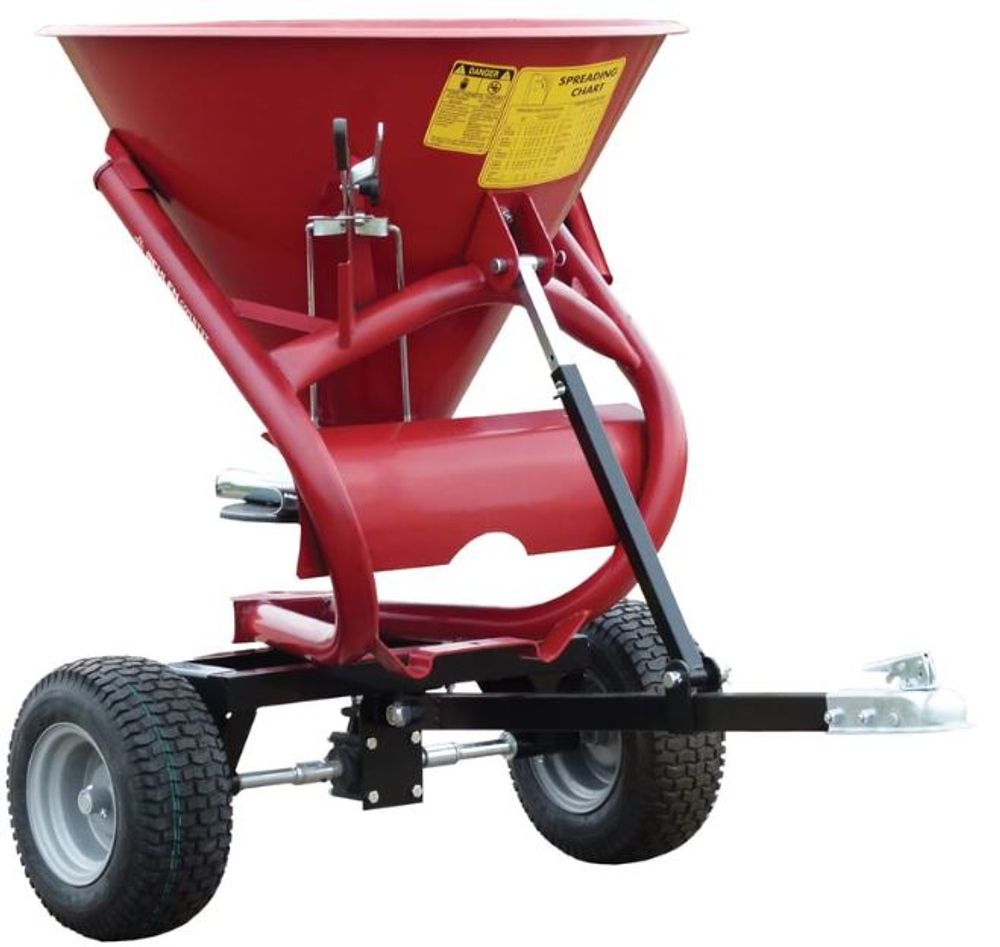
The ATV Seed and Fertilizer Spreader is a 500-pound-capacity, pull-behind broadcast spreader designed for distributing compatible grass seed, pasture seed, and granular fertilizer across fields, food plots, lawns, and larger properties. Its ground-driven gearbox operates as the spreader moves, allowing owners of compatible ATVs, UTVs, and utility vehicles to handle spreading jobs without a tractor PTO.
Featuring a polyethylene hopper, wind-drift shield, quick-connect trailer coupler, and adjustable material control, this tow-behind spreader is built for practical property and pasture maintenance. The large hopper helps reduce refill stops, while the ground-driven mechanism links spreading operation to vehicle movement. Explore additional farm and tractor implements for other land preparation and property maintenance tasks.
ATV Spreader Specifications
| Feature | Specification |
|---|---|
| Hopper capacity | 500 pounds |
| Hopper material | Polyethylene |
| Listed empty weight | 175 pounds |
| Drive system | Ground-driven gearbox |
| Hitch | Quick-connect trailer coupler |
| Compatible vehicle types | Suitable ATVs, UTVs, and utility vehicles |
| Wind-drift shield | Included |
| Height | 60 inches |
| Length | 50 inches |
| Width | 54 inches |
Capacity note: The 500-pound specification refers to the maximum listed hopper load, not the spreader's empty weight. Actual material volume depends on bulk density. Do not exceed the equipment's rated load or the towing vehicle's capabilities.
How the Ground-Driven ATV Spreader Works
Unlike a PTO-powered tractor spreader, this unit uses a ground-driven gearbox. As the spreader is pulled forward, wheel movement powers the spreading mechanism.
The design provides a mechanical relationship between ground movement and spreading operation, without requiring a separate tractor PTO connection. It can be useful for property owners who already operate an ATV or UTV and need to distribute seed or granular fertilizer over areas too large for convenient hand spreading.
Ground-driven operation does not automatically guarantee an exact application rate. Material density, particle size, flow-control setting, wheel traction, travel speed, and pass spacing can all influence distribution.
For consistent results, calibrate the spreader using the actual material before beginning a full application.
500-Pound Poly Hopper for Larger Spreading Jobs
The polyethylene hopper is designed to carry up to 500 pounds of compatible spreading material. Its capacity can reduce the number of refill stops when covering pastures, wildlife food plots, and larger managed properties.
A poly hopper also avoids the rust concerns associated with an exposed steel hopper, although metal components elsewhere on the spreader still require cleaning and maintenance.
The amount of material that fits in the hopper varies with density. Lightweight grass seed occupies considerably more volume per pound than many granular fertilizers. Plan loads according to both the hopper's capacity and the material manufacturer's handling instructions.
ATV Seed Spreader Product Photos
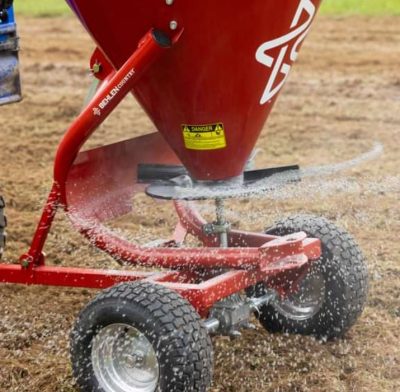
Broadcasting Material in the Field
The original photograph shows the spreader distributing material during operation.

Spreader Arms and Mechanism
This close-up shows components of the spreading assembly.

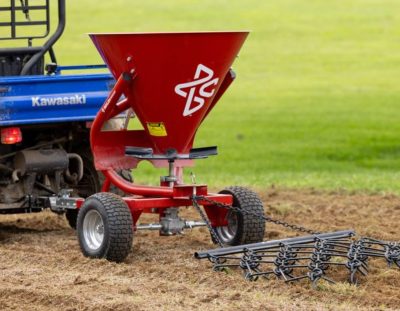
Spreader Used With a Harrow
The original photograph illustrates a field setup with the spreader and trailing harrow. Verify any additional towing or attachment arrangement against the equipment manufacturer's instructions before attempting a similar configuration.

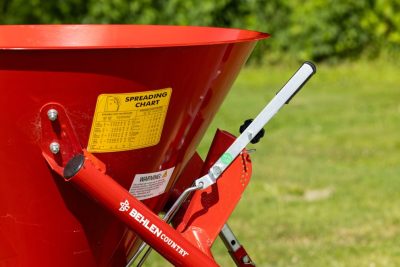
Material Control Arm
The control mechanism is an important part of setting and managing material delivery.
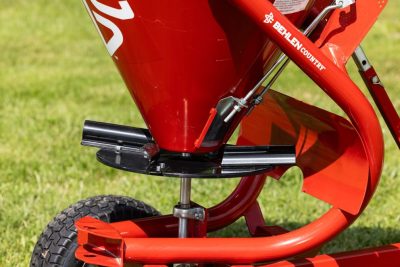
Spreader Throw Ring
The spreading assembly helps distribute material as the ground-driven mechanism operates.
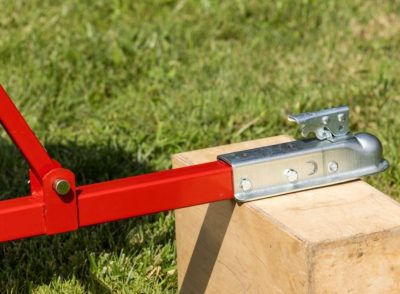
Trailer Hitch Connection
Review the hitch arrangement when checking compatibility with your towing vehicle.
Common Uses for a Pull-Behind Seed and Fertilizer Spreader
Pasture Seeding and Overseeding
The spreader can be used to distribute compatible pasture seed over prepared ground or existing pasture where broadcast seeding is appropriate.
Successful establishment depends on seed selection, soil conditions, planting timing, seed-to-soil contact, and subsequent moisture. Broadcasting seed alone does not guarantee germination or a successful stand.
When preparing new ground, other equipment from the tractor implements collection may be useful for soil preparation or finishing operations.
Wildlife Food Plots
ATV and UTV spreaders can be useful for distributing appropriate seed blends across food plots that are accessible to smaller utility vehicles.
Match the seed blend to local growing conditions and calibrate the spreader for the particular seed. Different seeds may require different settings, and mixed materials can separate during handling.
Granular Fertilizer Application
The spreader can distribute compatible dry granular fertilizer across managed fields and larger properties.
Follow the fertilizer label for application rate, protective equipment, environmental precautions, and any restrictions on use. Keep fertilizer out of waterways and avoid spreading under unsuitable wind or weather conditions.
Lawn and Property Maintenance
For larger lawns and managed properties, a tow-behind spreader may reduce the time required compared with a small handheld unit.
Consider whether the spread pattern and machine dimensions are appropriate for the area. Narrow lawns, landscaped obstacles, and small irregular spaces may be easier to manage with smaller spreading equipment.
What About Sand and Ice Melt?
Not all bulk materials are suitable for a broadcast seed and fertilizer spreader. Sand, damp materials, and some ice-melt products may bridge, clog, abrade components, or cause corrosion.
Use these materials only if the manufacturer specifically approves them for this model. Do not assume compatibility solely because the hopper can hold their weight.
How to Calibrate an ATV Seed Spreader
Calibration is essential when applying seed or fertilizer at a specified rate. A spreader that distributes material unevenly can leave gaps, create overlapping bands, or apply more product than intended.
1. Determine the Required Application Rate
Start with the seed or fertilizer manufacturer's recommended rate for the intended application. Express the rate in pounds per acre or another suitable area measurement.
2. Choose a Starting Flow Setting
Use the spreader's adjustment instructions and any available seed chart to select an initial material-control setting.
Because materials differ in size, density, and flow characteristics, a chart is a starting point rather than a guarantee of the final rate.
3. Measure a Test Area
Select a measured area where you can safely evaluate material distribution. Determine how much material is delivered over that area using the actual operating setup.
For example, if your target application rate is 100 pounds per acre, the corresponding amount for one-quarter acre is 25 pounds.
4. Check the Spread Pattern
Observe how material is distributed across the effective spreading width. The distance material travels from the spreader may not equal the recommended spacing between passes.
Adjust your pass spacing based on the tested distribution pattern, accounting for overlap where necessary.
5. Recheck When Conditions Change
Changing seed type, fertilizer formulation, material moisture, travel conditions, or adjustment settings may require another calibration test.
Maintaining a consistent travel pattern helps produce more predictable results.
Wind-Drift Shield and Material Distribution
The included wind-drift shield is intended to help direct material during spreading and reduce unwanted drift toward the towing vehicle.
It does not eliminate wind effects or guarantee that every particle reaches the intended location.
For best results, operate under suitable weather conditions and verify the spread pattern. Avoid applications when wind could carry seed or fertilizer into unintended areas.
ATV and UTV Towing Compatibility
The spreader is equipped with a quick-connect trailer coupler and is described for use with suitable ATVs, UTVs, and small utility vehicles.
Before purchasing, confirm the hitch configuration and the towing vehicle's rated capacity. The spreader has a listed empty weight of 175 pounds and a maximum hopper load of 500 pounds, giving a combined listed equipment-and-material weight of approximately 675 pounds before considering any other attachments or accessories.
Verify the vehicle's towing rating, hitch rating, tongue-weight limits, braking performance, and the conditions in which the spreader will operate. Do not assume that every ATV or UTV can safely tow the spreader at maximum capacity.
Use particular caution on slopes, soft ground, uneven terrain, and when turning with a loaded hopper.
Spreader Video
The original product listing includes the following video of the spreader. Use it alongside the manufacturer's operating instructions when reviewing the equipment and its features.
Cleaning and Maintaining the Spreader
Empty the Hopper After Use
Remove unused seed or fertilizer after completing the job. Leaving material in the hopper can encourage moisture accumulation, clumping, and corrosion of exposed metal components.
Clean the Spreading Mechanism
Follow the manufacturer's cleaning instructions for the hopper, discharge opening, and spreading assembly. Pay attention to residue around moving parts and the material-control mechanism.
Inspect the Ground-Drive System
Check the gearbox, drive components, wheels, and related hardware for damage or unusual wear. Follow the manufacturer's lubrication and maintenance schedule.
Check Tires and Hitch Hardware
Before towing, inspect tire condition, inflation pressure, hitch connections, and retaining hardware. Do not operate with damaged or unsecured components.
Store in a Suitable Location
Store the spreader clean, empty, and protected from unnecessary exposure to moisture. Inspect the equipment again before its next use.
Frequently Asked Questions
How much seed or fertilizer can this ATV spreader hold?
The hopper has a listed capacity of up to 500 pounds. The volume that fits depends on the density of the material being spread.
Does the spreader need a PTO?
No. Its spreading mechanism is powered by a ground-driven gearbox rather than a tractor PTO.
Can I pull it with a UTV?
The spreader is described for compatible ATVs, UTVs, and utility vehicles. Confirm the hitch arrangement, towing rating, braking ability, and operating conditions before use.
How much does the spreader weigh?
The original product description lists an empty weight of 175 pounds. With a full 500-pound hopper, the combined listed weight is approximately 675 pounds, excluding any additional equipment.
Does the spreader automatically apply the correct amount?
No. The ground-driven gearbox operates with vehicle movement, but accurate application still requires calibration, appropriate flow settings, and a consistent spreading pattern.
Can I spread pasture grass seed?
Yes, provided the specific seed is compatible with the spreading mechanism. Calibrate the unit for the seed type and desired application rate.
Can it apply granular fertilizer?
It is designed for compatible granular fertilizer. Follow the fertilizer label and the equipment manufacturer's instructions.
Can I use it for sand or ice melt?
Only if the manufacturer confirms that the particular material is suitable for this spreader. Some materials can clog or damage the equipment.
Does the wind shield eliminate drift?
No. The shield helps manage material direction, but wind and application conditions still affect distribution.
Can the spreader pull a harrow?
An original product photograph shows a spreader and harrow arrangement. However, do not attach additional equipment unless the manufacturer confirms that the configuration is supported and within all applicable towing limits.
How do I request a shipping quote?
Contact Barn World with your delivery ZIP code and desired quantity to confirm availability and shipping arrangements.
Order the ATV Seed and Fertilizer Spreader
The 500-pound ATV Seed and Fertilizer Spreader offers a practical option for broadcasting compatible seed and granular fertilizer across pastures, food plots, and larger properties. Its ground-driven design, polyethylene hopper, and tow-behind configuration make it useful for owners who want to work with a suitable ATV or UTV.
Before ordering, verify towing compatibility and confirm that the materials you plan to spread are appropriate for the equipment.
For availability, product questions, or freight information, contact Barn World at (720) 238-2190 or Sales@BarnWorld.com. Include your delivery ZIP code and quantity when requesting a quote.
For additional field preparation and land management equipment, browse our tractor and farm implements.