
Standard Cattle Guards
Standard Cattle Guards
This collection is empty
Recently viewed
Barn World carries a standard category of cattle guards designed for use on private property. Not everyone needs the over-built and engineered highway rating of 16 tons per axle and we got a lot of calls for a more economical option for use on private property. What we call the standard, or private use design is built for common driveway traffic, including fully loaded semis.
These rugged livestock barriers are by far our most popular and have been in use around the country for decades. We estimate their load-carrying capacity at 12 tons per axle, well above what is used around the farm and more than enough for a tractor-trailer load.
This is the most economical steel cattle guard category and will provide easy access to your pastures while eliminating the need for gates. You can see the round top rail cattle guards here. Shop Now
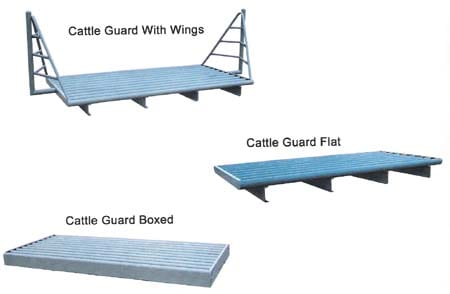
All of the Standard Guards are made from NEW Schedule 40 steel. All ends of the top rail pipe are capped to prevent rust. Bolt-on wings and boxed cattle guards are available with all sizes and are finished in gray enamel.
Types of Cattle Guards
- Boxed Cattle Guards
- Flat Cattle Guard Foundations
- Cattle Guard Wings
- Cattle Guard for Deer
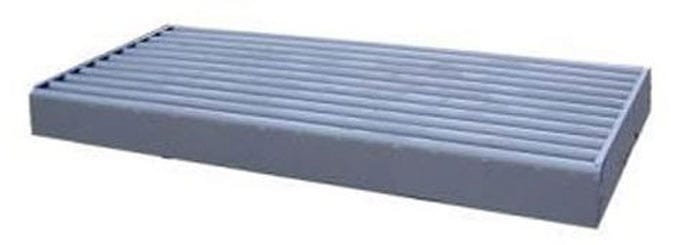
Boxed Cattle Guards lie directly on the ground
This style is designed to sit directly on the ground without concrete footings and it's an available option on all the round rail designs. What we've done is welded a steel skirt to the perimeter to keep dirt from creeping in underneath. This also allows you to make a dirt ramp on either side to help vehicles cross without it running underneath. The weight of crossing vehicles is transferred from the top rails to the c-channels below and then directly to the ground. Unlike a traditional installation, the weight is directed through the full length of the channels rather than just on the ends.
The fixed box design is popular in low traffic or remote areas like cell towers, farms and ranches as well as temporary sites. In fact a lot of construction companies use them as wash bays or rumble strips for equipment leaving a site. They can also pick them up when done and move on to the next job.
The removable box option makes it convenient to remove the guard without disturbing the surrounding installation area. The boxed section does not carry any of the load, it's a separate and individual frame the guard sits in and provides no structural support at all.
Fixed Boxed Option
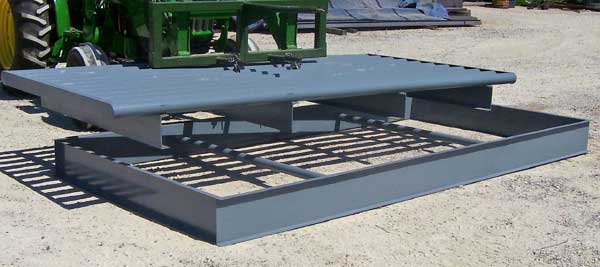
Because they do rest directly on the ground, a few precautions should be noted. A flat ground area is a must as any kind of slope will allow it to 'walk' or travel downhill. A lot of customer will bury railroad ties to anchor them and help prevent walking. The issue is drainage. We'd of course recommend a local contractor familiar with the site conditions be consulted and would suggest a bed of crushed gravel be used as well. This will help drain water away from your crossing and preserve the installation area.
Flat Cattle Guard Foundations
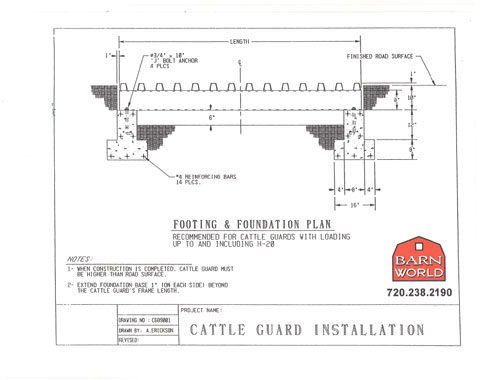
The traditional installation calls for a concrete foundation to anchor to and transfer weight to the ground. A 'flat' style design is mounted to a poured-cement footing in the ground and bolted directly to prevent movement. This permanent installation allows for heavy-duty and high-traffic crossing without concerns of movement or settling. We usually see the rated cattle guards used for these public highway construction projects that require the load ratings that private use designs don't call for.
Below is a generic foundation diagram for reference. Please note that every site is different and a qualified professional should be used to ensure a proper, long-lasting installation.
Cattle Guard Wings
This is an essential option to prevent your cows from simply walking around your barrier. The wings allow you to tie the fencing directly to the guard so they can't step around the connection. If a single fence post is planted next to the middle of the grid, livestock are able to bend around the post and walk next to the side of the steel and go on their merry way!
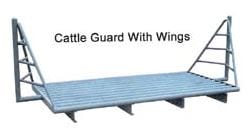
As you can see from the picture above, the wing takes the vertical structure of the fence and spreads it horizontally to the bottom of the grid. This effectively creates a 'horizontal fence' so your animals can't walk around the guard.
Cattle Guard for Deer
A note on using these barriers for deer. Believe it or not, deer are much better jumpers than cows! Depending on the type of deer in your area, they can easily clear a 12' long jump and won't even think about flying over. We suggest at least 16' in the direction of vehicle travel be created to discourage jumpers.
To get that kind of 'depth', we can lay two sections next to each other and bolt them together. We can pre-drill holes upon request so you can just connect them in the field when they're delivered. Just remember to check that your fencing is tall enough to keep them out as well!
Buying a Cattle Guard
If you need any help to determine what configuration would be most effective for your project, feel free to give us a call anytime at (720) 238-2190 and we'll be happy to help. Send us an email and we'll reply with a quote with shipping. See our entire cattle guard selection here Shop Now